
The Quiet Revolution in Your Trading Account
Let’s get real for a second. You’ve probably seen those flashy screenshots on social media—traders turning $10 into $10,000 in a single afternoon using insane leverage. We’ve all been tempted by that high. But if you’re reading this in 2026, you already know the truth: most of those accounts are blown by the next morning. The traders who actually survive and thrive on Deriv aren’t the ones looking for a one-hit wonder. They are the ones who understand the slow, relentless power of compounding.
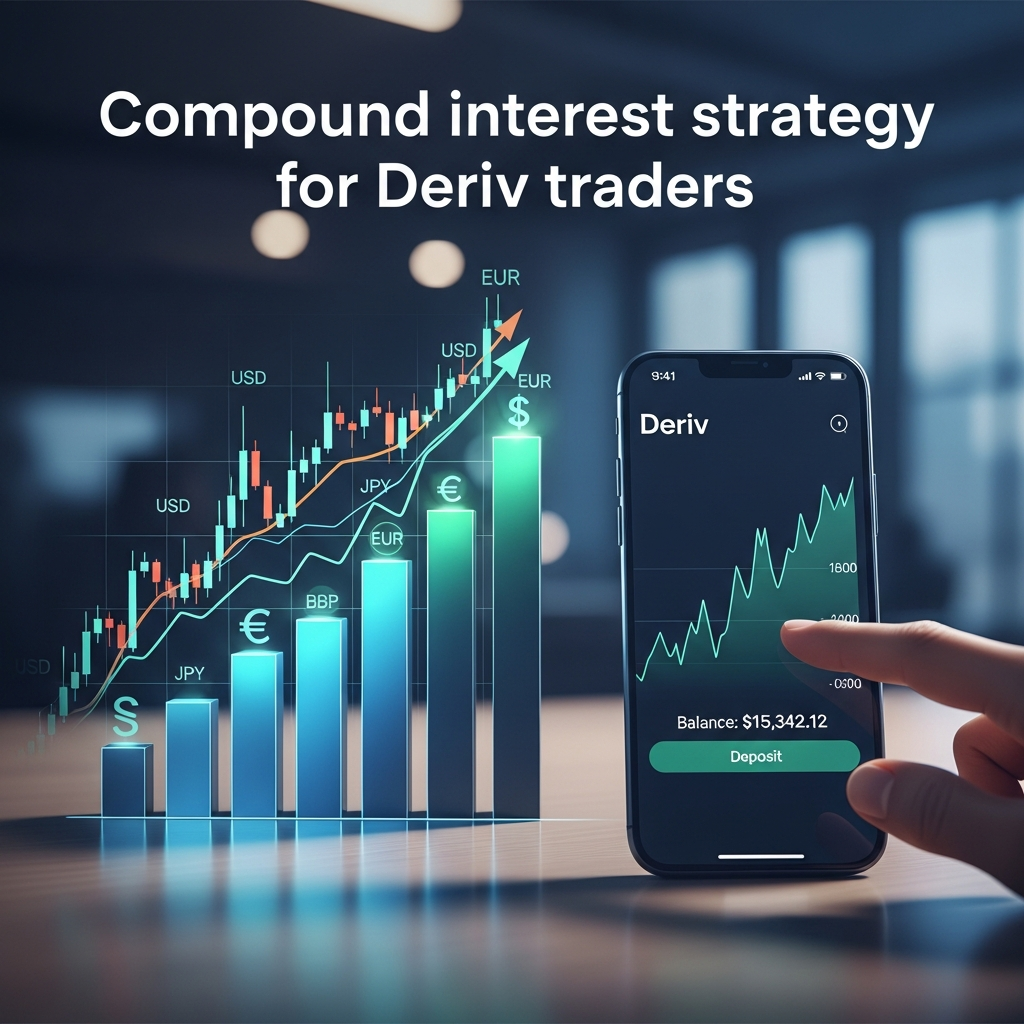
A Compound interest strategy for Deriv traders is not about making a million dollars today. It’s about making a consistent 2% or 3% and letting the math do the heavy lifting for you. When Albert Einstein called compound interest the eighth wonder of the world, he wasn’t thinking about Volatility 75 Index (V75) trades, but the principle applies perfectly to our modern markets. If you can master your emotions and follow a strict plan, the trajectory of your account will eventually shift from a flat line to a vertical spike.
Why Deriv is the Perfect Playground for Compounding
Deriv offers something that traditional forex brokers often lack: consistency in market availability. Because Deriv specializes in synthetic indices—markets that are cryptographically generated and mimic real-world market movements—they run 24/7, 365 days a year. This is a massive advantage for anyone using a compounding plan.
Think about it. In traditional markets, you lose trading days to weekends and bank holidays. On Deriv, your compounding cycle never has to stop. Whether you prefer the rhythmic pulses of the Volatility Indices, the sudden movements of Crash and Boom, or the steady climb of Step Index, you have a constant stream of opportunities to hit your daily percentage targets.
Moreover, the flexibility of trade sizes on Deriv is a godsend. Whether you have a $50 account or a $50,000 account, you can scale your lot sizes with precision. This precision is the backbone of any successful Compound interest strategy for Deriv traders. You need to be able to increase your position size incrementally as your balance grows, and Deriv’s platform, especially on MT5 (DMT5), allows for that granular control.
The Blueprint: Setting Realistic Compounding Goals
The biggest mistake I see traders make is setting goals that are mathematically unsustainable. If you try to double your account every day, you are essentially gambling, not trading. You will hit a losing streak, and because your risk is so high, you’ll be back at zero before you can say “margin call.”
A sustainable strategy focuses on small, repeatable wins. Let’s look at the math for a moment. If you start with $500 and aim for a modest 3% daily return, reinvesting your profits every day, where do you think you’d be after a year? The numbers are staggering. But here’s the catch: you won’t win every day. That’s why your strategy needs to account for the days you lose.
- The 1% Rule: Never risk more than 1% of your current balance on a single trade. As your balance grows, your 1% becomes a larger dollar amount, but the risk to your account remains the same.
- The Daily Target: Aim for a 2-5% net gain per day. Once you hit it, walk away. The hardest part of compounding isn’t the trading; it’s the stopping.
- The Drawdown Buffer: Accept that you will have losing days. A 3% loss today doesn’t ruin the strategy; it’s just a minor speed bump on the road to exponential growth.
Choosing Your Weapons: Best Deriv Assets for Compounding
Not all assets on Deriv are created equal when it comes to compounding. Some are too erratic, while others provide the steady trends we need. In 2026, the favorite for many remains the Volatility Indices, specifically V10, V25, and V75.
The Reliability of Volatility 75 (V75)
V75 is the gold standard for many Deriv traders. It respects technical analysis beautifully. Support and resistance levels, trendlines, and Fibonacci retracements work here with surprising frequency. For a compounding strategy, you want an asset that is predictable. You don’t need high volatility; you need reliable volatility.
Crash and Boom: The Psychological Test
Crash 500/1000 and Boom 500/1000 offer unique opportunities for compounding, but they require nerves of steel. If you are “scalping” the small candles against the spikes, you are essentially picking up pennies in front of a steamroller. However, if you catch the spikes or use a price action approach on higher timeframes (H1 or H4), these indices can provide the high-probability setups needed to fuel your compound growth.

The Mechanics of Scaling Your Lot Size
How do you actually execute a Compound interest strategy for Deriv traders on the platform? It comes down to your lot size calculator. In the beginning, you might be trading the minimum lot size on V75 (0.001). As your account grows from $100 to $200, you don’t just stay at 0.001. You move to 0.002.
This sounds simple, but it’s where most people fail. They get impatient. They see their account hit $500 and think, “I can handle a 0.05 lot size now.” No, you can’t. That’s skipping steps. Compounding is a ladder; if you try to jump five rungs at once, you’re likely to slip and fall. Stick to the math. Every weekend, look at your new balance and calculate your lot sizes for the upcoming week based on your 1% risk rule.
Psychology: The Hidden Enemy of Compounding
Let’s talk about the thing no one likes to admit: trading is boring when you do it right. A successful compounding journey is actually quite repetitive. You wake up, check your setups, take your 1-3 trades, hit your target (or your stop loss), and close the laptop. There’s no adrenaline rush in a 2% gain.
The problem arises when the account starts getting “big.” It’s easy to risk 1% when your account is $100—that’s only a $1 risk. But when your account grows to $10,000, that 1% risk is $100. Suddenly, the stakes feel higher. You might start hesitating on your entries or, worse, moving your stop losses because you don’t want to lose a “real” amount of money. This is why you must decouple the dollar amount from the percentage. To the successful trader, $1 and $1,000 are the same thing: they are both just units of risk.
Step-by-Step Implementation for 2026
If you’re ready to start today, here is the roadmap I would suggest for any Deriv trader looking to build long-term wealth.
Step 1: The Foundation
Start with a capital amount you are comfortable losing, but large enough to take seriously. For many, this is between $200 and $500. Open a Deriv MT5 account and choose one or two indices to master. Don’t try to trade everything. Become the master of one.
Step 2: Define Your Edge
You need a strategy with a positive expectancy. This could be a simple EMA crossover, a price action break-and-retest, or using the RSI for overbought/oversold conditions in a trending market. It doesn’t have to be complex; it just has to work more than 50% of the time with a 1:2 risk-to-reward ratio.
Step 3: The Compounding Spreadsheet
Create or download a compounding spreadsheet. Input your starting balance and your daily target. Having a visual representation of where you could be in six months is a powerful motivator during the inevitable slow periods. Seeing that your $500 could be $5,000 by staying disciplined is often the only thing that keeps you from overtrading.
Step 4: Weekly Audits
Every Sunday, review your trades. Did you stick to your lot sizes? Did you revenge trade? Adjust your lot sizes for the new week based on your current balance. This is the moment where the “compound” part of the Compound interest strategy for Deriv traders actually happens.
Risk Management: The Safety Net
You cannot compound a zero balance. Protection of capital is your first, second, and third priority. In 2026, market conditions can shift rapidly. Using tools like trailing stops can help you lock in profits as a trade moves in your favor, ensuring that a winning trade doesn’t turn into a loser.
Also, consider the “Withdrawal Strategy.” Some traders prefer to compound 100% of their profits. Others prefer a hybrid model: compound 70% and withdraw 30% weekly for living expenses or to build a “emergency fund” outside of Deriv. This can take the pressure off your trading, knowing that you’ve already taken some “real” money off the table.
Common Pitfalls to Avoid
I’ve seen brilliant traders lose everything because they fell into these traps. Don’t let it be you.
- The “One Big Trade” Mentality: You get frustrated with slow progress and decide to “boost” the account with a massive lot size. This is the death of compounding.
- Ignoring Market Context: Just because your strategy says “buy” doesn’t mean you should if there’s a major news event or if the higher timeframe trend is clearly against you.
- Technical Burnout: Spending 12 hours a day staring at V75 charts. Your brain will get tired, you will make mistakes, and you will break your compounding rules. Trade your plan, then live your life.
Looking Ahead: Compounding in the Modern Era
As we move further into 2026, the tools available to us are better than ever. We have AI-driven sentiment analysis and more robust automated trading options on Deriv. However, the core principle of a Compound interest strategy for Deriv traders remains unchanged. It is a human endeavor that requires human discipline.
The math is infallible, but the human mind is chaotic. If you can bridge that gap—if you can force your mind to follow the math—the results will eventually look like magic. It’s not about the $10 you make today. It’s about what that $10 becomes when it’s allowed to grow, undisturbed, over the next few hundred trades. Stop looking for the moonshot. Start building the staircase. Your future self will thank you for the patience you showed today.