The Great Platform Dilemma: Which Deriv Interface Actually Works for You?
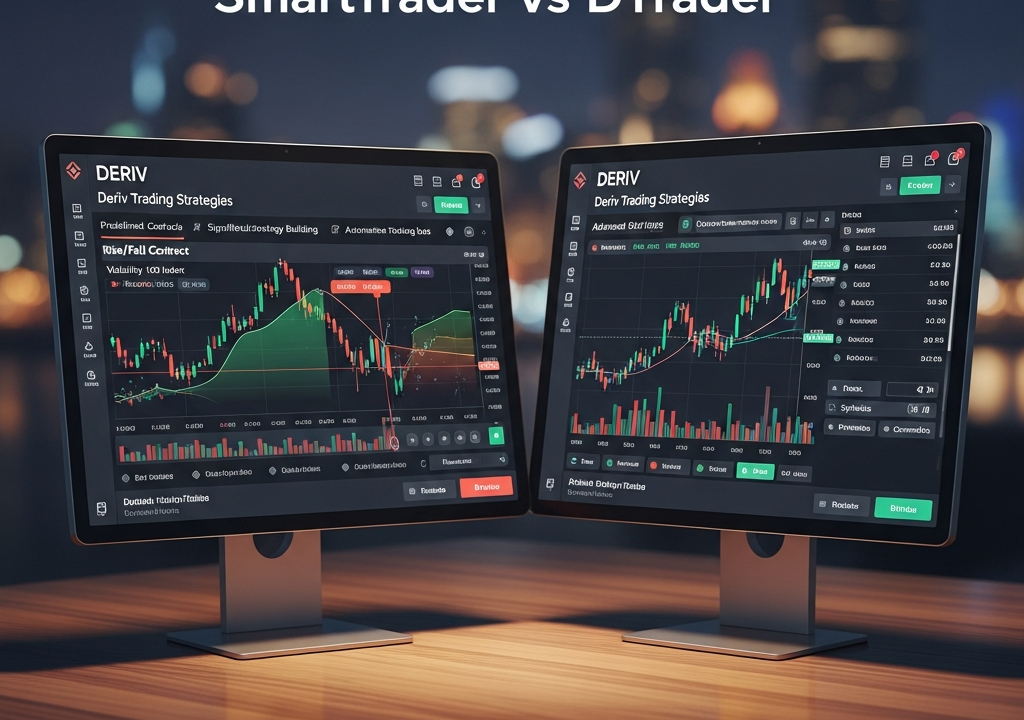
I remember the first time I logged into my Deriv account back in the day. I was greeted by a menu that felt like a buffet at a high-end hotel—there were just too many choices. You have MT5 for the hardcore forex enthusiasts, Deriv X for the adventurous, and then the two primary browser-based options that seem to do the same thing but look completely different. I’m talking about the Deriv SmartTrader vs DTrader comparison that every beginner (and quite a few pros) eventually has to face.
It is 2026, and while trading technology has leaped forward with AI-driven signals and lightning-fast execution, the core question remains: do you want a platform that feels like a classic cockpit, or one that feels like a modern smartphone app? Choosing between SmartTrader and DTrader isn’t just about picking a pretty interface; it’s about how you process information under pressure and which specific trade types you rely on to grow your balance.

SmartTrader: The Reliable Old Guard
Let’s start with SmartTrader. If you’ve been around since the Binary.com days, SmartTrader will feel like coming home. It’s the legacy interface that Deriv kept alive for a very good reason: it works without any fluff. When I use SmartTrader, I feel like I’m looking at a tool designed for a specific job. There are no distracting animations or heavy graphics to slow down a mediocre internet connection.
The Layout and Workflow
SmartTrader uses a very linear, top-down approach. You select your market (like the Volatility 75 Index or EUR/USD), you choose your trade type (Rise/Fall, Higher/Lower, Digits), and you set your duration. Everything is laid out in clear drop-down menus. It’s remarkably efficient for traders who already know exactly what they want to do.
One thing I’ve noticed is that SmartTrader is particularly popular with the “Digit” trading community. If you are into Digit Matches/Differs or Even/Odd strategies, the simplified interface allows you to keep your eyes on the last digit list without the clutter of a massive candle chart taking up 80% of your screen real estate.
DTrader: The Modern Powerhouse
Now, let’s flip the coin. DTrader is Deriv’s answer to the modern trader’s demand for a visual, immersive experience. If SmartTrader is a spreadsheet, DTrader is a high-definition video game. The moment you switch over, you’re met with a beautiful, expansive chart that lives and breathes right in the center of your browser.
Why DTrader Feels Different
In this Deriv SmartTrader vs DTrader comparison, the visual feedback is the most striking difference. On DTrader, you can see your entry spot and your exit potential directly on the chart. There’s something psychologically reassuring about seeing that little barrier line move in real-time. It makes the market feel tangible.
DTrader is also where Deriv showcases its most innovative trade types, like Multipliers. If you haven’t tried Multipliers yet, they are essentially a way to get the upside of leverage without the risk of a margin call. You can only lose your stake, but your profit potential is multiplied. The DTrader interface handles the complexity of Multipliers—with their take-profit and stop-loss levels—much more intuitively than the old-school SmartTrader layout ever could.

Direct Comparison: Side-by-Side Analysis
To really get to the heart of the Deriv SmartTrader vs DTrader comparison, we need to look at specific categories that impact your daily P&L. Let’s break down where each platform shines and where they might leave you wanting more.
1. Charting Capabilities
If you are a technical analyst who loves drawing Fibonacci retracements and complex trendlines, DTrader is your winner. It integrates a powerful charting engine that allows for deep customization. You can change candle types, add dozens of indicators, and keep multiple timeframes open. SmartTrader has charts, but they feel like an afterthought, usually opening in a separate popup window that can be clunky to manage if you’re trying to time a fast-moving market.
2. Speed of Execution
Speed is a tricky one. In terms of technical latency, both platforms are hosted on the same robust Deriv servers. However, the perceived speed is different. DTrader’s one-click trading is incredibly fast. You see the price, you click “Up,” and the trade is live. SmartTrader requires a bit more navigation through menus. However, SmartTrader is “lighter.” If you are trading on an old laptop or a shaky 4G connection in a remote area, SmartTrader will often load and respond faster because it isn’t trying to render complex 4K-ready charts.
3. Available Trade Types
- SmartTrader: Best for classic Options. It handles Rise/Fall, Higher/Lower, Touch/No Touch, and Digits with a very clean, form-based input.
- DTrader: Best for Multipliers, Accumulators, and Vanillas. These newer contract types require a more dynamic interface to manage risk levels effectively, which DTrader provides in spades.
The User Experience: A Tale of Two Traders
Think about your own personality for a second. I have a friend, let’s call him Mark, who has been trading for a decade. Mark hates “flashy stuff.” He uses a terminal-style setup and thinks dark mode is a distraction. For Mark, the Deriv SmartTrader vs DTrader comparison ends before it begins—he’s a SmartTrader loyalist. He likes the predictability. He likes that the buttons never move.
Then there’s Sarah. Sarah started trading in 2026. She’s used to apps like Robinhood or high-end crypto exchanges. When she looks at SmartTrader, she thinks it looks like a website from 2010. She needs the visual confirmation that DTrader offers. She wants to see the trendline she drew intersect with the price action at the exact moment she clicks “Buy.”
Neither is wrong. The beauty of Deriv is that your account balance is shared across both. You can literally have SmartTrader open in one tab to check the Digit stats and DTrader open in another to watch the macro trend on a Volatility Index.
Technical Tools and Customization
When we dive deeper into the technical side, DTrader starts to pull ahead for the modern strategist. In 2026, we have access to more data than ever. DTrader allows you to customize your workspace, shifting the position of the trade panel and adjusting the chart’s appearance to reduce eye strain during long sessions. It also features a more integrated “Journal” or trade history view, making it easier to review your wins and losses without leaving the main screen.
SmartTrader, conversely, keeps things static. This might sound like a negative, but there is a psychological benefit to a static interface. It reduces the “cognitive load.” When the interface never changes, your brain can focus entirely on the numbers and the market rhythm. There is no temptation to fiddle with chart colors or move windows around.
Mobile Trading: The Browser Experience
While Deriv has dedicated apps like Deriv GO, many of us still prefer trading via a mobile browser. In the Deriv SmartTrader vs DTrader comparison for mobile users, DTrader is the clear victor. It was built with a “mobile-first” philosophy. The buttons are thumb-friendly, and the chart scales beautifully to a vertical screen.
Trying to use SmartTrader on a smartphone is a bit like trying to read a desktop-sized newspaper on a postcard. You’ll find yourself zooming in and out, scrolling left and right to find the “Purchase” button. If you’re on the move, stick to DTrader or the dedicated app.
Which One Should You Choose?
Choosing your primary platform shouldn’t feel like a life-long commitment, but it does help to specialize. If you’re still on the fence after reading this Deriv SmartTrader vs DTrader comparison, ask yourself these three questions:
- Do I trade based on visual patterns or mathematical statistics? If patterns, go DTrader. If stats and digits, go SmartTrader.
- Is my internet connection consistently fast? If yes, DTrader’s rich interface is a joy. If no, SmartTrader’s low-data footprint is a lifesaver.
- Am I interested in Multipliers? If yes, don’t even bother with SmartTrader; the DTrader experience for Multipliers is vastly superior.
Final Thoughts for the 2026 Trader
The landscape of online trading is constantly shifting, but the need for a reliable interface is constant. Whether you prefer the streamlined, no-nonsense vibe of SmartTrader or the feature-rich, high-octane environment of DTrader, the most important factor is your comfort level. A trader who is comfortable is a trader who makes better decisions.
Don’t be afraid to experiment. Use the demo account to spend a week on each. You might find that you prefer SmartTrader for your morning coffee sessions when you’re looking for quick digit trades, and DTrader in the afternoon when you’re settling in for a longer session of analyzing market trends. The Deriv SmartTrader vs DTrader comparison doesn’t have to result in a winner and a loser—it’s about finding the right tool for the specific trade you’re making today.
The markets aren’t going anywhere, but your focus can slip if you’re fighting with your interface. Pick the one that feels like an extension of your own mind, and you’ll already be steps ahead of the competition.