The High-Stakes Gamble of Blind Trading
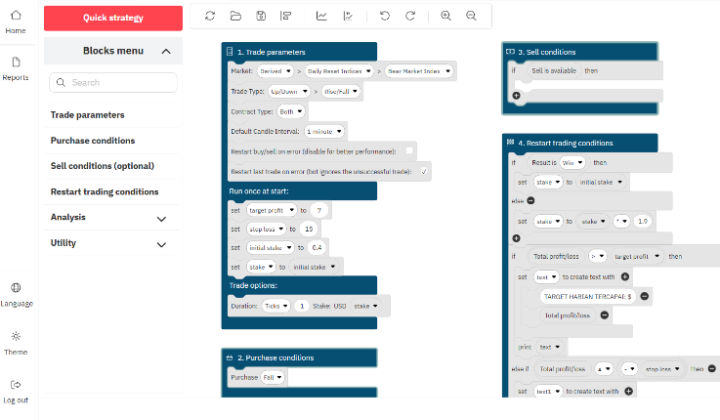
I remember the first time I clicked the ‘Run’ button on a Deriv bot I’d spent all night building. My heart was thumping against my ribs. I had this vision of a compounding balance that would eventually let me quit my day job. Within fifteen minutes, my virtual account—thankfully, it was just the virtual one—was down by 40%. The strategy looked perfect in my head, but the market didn’t care about my feelings. It cared about math, volatility, and logic.
That was the moment I realized that building a bot is only 20% of the work. The other 80%? That’s where deriv bot backtesting software comes into play. If you aren’t testing your ideas against historical data, you aren’t trading; you’re just throwing digital darts in a dark room and hoping you hit a bullseye. In 2026, the markets are faster and more complex than ever. Relying on ‘gut feeling’ or a ‘lucky’ XML file you found on a Telegram group is a fast track to a zero balance.
What Exactly Is Deriv Bot Backtesting Software?
Let’s break the jargon down into something we can actually use. Backtesting software is essentially a time machine for your trading strategy. It takes your bot’s logic—your entry points, your stake levels, your Martingale multipliers, and your exit conditions—and runs them through months or years of past market data in a matter of seconds. Instead of waiting three weeks to see if your bot survives a volatile market trend, you see the result instantly.
In the context of the Deriv ecosystem, which includes DBot and the legacy Binary Bot platform, this software usually manifests in three ways. First, you have the built-in ‘Run’ feature on virtual accounts, which is a form of forward-testing. Second, there are third-party XML analyzers that take your trade logs and dissect them. Third, and most powerful, are dedicated simulation environments that use CSV exports of historical tick data to run high-speed iterations of your strategy.
The Difference Between Forward-Testing and Backtesting
Many traders get these two confused. Forward-testing is when you run your bot on a demo account in real-time. It’s useful, but it’s slow. If you want to see how your bot performs during a massive market crash, you have to wait for a crash to happen. Backtesting using deriv bot backtesting software allows you to jump back to the specific moments of high volatility in 2026 or early 2026 to see if your stop-loss would have actually saved you.
Why Most Traders Skip This Crucial Step
If backtesting is so great, why doesn’t everyone do it? Honestly? It’s because of laziness and the ‘lottery ticket’ mentality. We want the win right now. We don’t want to spend four hours analyzing a spreadsheet of tick data. We want to see the green numbers popping up on the screen immediately.
Another hurdle is the perceived technical barrier. People think they need to be a Python wizard or a data scientist to use deriv bot backtesting software. While some high-end tools do require coding knowledge, the landscape has changed significantly by 2026. There are now plenty of user-friendly interfaces that allow you to drag and drop your XML files or strategy blocks and get a comprehensive risk report without writing a single line of code.
The Essential Features of a Good Backtester
When you are scouting for the right tool to validate your bots, don’t just grab the first free tool you find. A subpar tester can be more dangerous than no tester at all because it gives you a false sense of security. Here is what you should be looking for:
- Tick-Level Accuracy: Many simple testers only use 1-minute or 5-minute candles. For Deriv bots, especially those trading Volatility Indices or synthetic markets, you need tick-by-tick data. The difference of a single millisecond can change a win to a loss.
- Customizable Stake Logic: Your software needs to handle complex money management. Can it simulate a 1.5x Martingale? Can it handle a D’Alembert strategy? If the software can’t replicate your specific recovery logic, the results are useless.
- Drawdown Analysis: This is the big one. You need to know the ‘Max Drawdown’—the furthest your account dipped before recovering. If your bot made $1,000 profit but had a $5,000 drawdown at one point, you would have blown a $2,000 account long before reaching that profit.
- Speed and Scalability: In 2026, we expect results fast. Good software should be able to run 10,000 trades of simulation in under a minute.
How to Use Deriv Bot Backtesting Software: A Practical Approach
Let’s get practical. You’ve got a strategy. You think it’s a winner. Here is how you should approach the testing phase before you even think about putting real money on the line.
Step 1: The ‘Rough Cut’ on Virtual Accounts
Start by running your bot for 24 hours on a Deriv virtual account. This isn’t a true backtest, but it’s a ‘sanity check.’ It ensures your blocks are connected correctly and the logic isn’t fundamentally broken. If it fails here, there is no point in moving to advanced software.
Step 2: Exporting Your Data
Most deriv bot backtesting software requires a data feed. You can often export historical tick data directly from the Deriv API or use a tool that pulls this data for you. Look for ‘Synthetic Indices’ data specifically if that’s your niche, as these markets operate 24/7 and provide a massive dataset for testing.
Step 3: Stress Testing
This is where the magic happens. Once you load your strategy into the software, don’t just test it on ‘normal’ days. Seek out the outliers. Test it against periods of extreme trending or extreme ranging. A bot that works in a stable market is common; a bot that survives the ‘black swan’ events of 2026 is a goldmine.
The Psychology of the Data
There is a trap here that I see people fall into constantly: ‘Curve Fitting.’ This happens when you tweak your bot’s settings so perfectly that it performs incredibly on past data, but fails miserably the second you turn it on live. You’ve essentially trained your bot to win a race that has already been run.
To avoid this, use ‘Out-of-Sample’ testing. If you have data for the last six months, use the first four months to optimize your bot. Then, use the remaining two months (which the bot hasn’t ‘seen’ yet) to test it. If it still performs well, you might actually have something worth trading.
Common Pitfalls in Bot Simulation
Even with the best deriv bot backtesting software, you can still stumble. One major issue is ignoring execution latency. In a simulation, a trade happens instantly. In the real world, there’s a delay between the signal and the execution. This ‘slippage’ can eat into your margins, especially with high-frequency strategies.
Another pitfall is ignoring the contract types. Testing a ‘Rise/Fall’ strategy with ‘Digit Match’ data is a recipe for disaster. Ensure your software is specifically calibrated for the contract type you are using on the Deriv platform. The math behind Digits is vastly different from the math behind Over/Under or Touch/No Touch.
The ‘Martingale’ Illusion
I have to mention this because it’s the most common way Deriv traders lose money. Many bots look amazing in backtesting because they use an aggressive Martingale. The chart shows a beautiful, steady upward line… until it suddenly drops to zero. When backtesting, always look at your ‘Max Consecutive Losses.’ If your software tells you that you hit 12 losses in a row once in the last year, ask yourself: ‘Does my account have the balance to survive a 13th?’
The Future of Testing in 2026
As we move through 2026, the technology is getting scarily good. We are seeing the rise of AI-driven optimization within deriv bot backtesting software. Instead of you manually changing the ‘offset’ or ‘duration’ of a trade, the software uses machine learning to find the optimal settings for current market conditions. It’s like having a quant researcher working for you around the clock.
We are also seeing better integration with cloud computing. You no longer need a beefy PC to run millions of simulations. You can push your XML file to a cloud-based tester that runs it against five years of data across twenty different indices simultaneously, giving you a ‘risk score’ in minutes.
Finding Your Edge
The truth is that most people will read this and still won’t use a backtester. They’ll find a ‘free bot’ on a forum, load it up, and hope for the best. And that is exactly why the professional traders make money—they are the ones doing the work that others refuse to do. Using deriv bot backtesting software is about building confidence. When your bot hits a string of three losses in a row on a live account, you won’t panic and shut it off manually. Why? Because your backtesting showed you that a five-loss streak happens once every 200 trades, and your strategy is built to handle it.
Trading is a business of probabilities, not certainties. Your goal isn’t to find a bot that never loses; it’s to find a bot where the wins outweigh the losses over a long enough timeline. The only way to prove that timeline exists is through rigorous, honest testing.
A Final Thought on Strategy Longevity
No strategy lasts forever. A bot that crushed the markets in 2026 might be obsolete by mid-2026 because market dynamics shift. This is why backtesting isn’t a ‘one and done’ task. It’s a continuous process. You should be backtesting your ‘winning’ bots every single week to see if their performance is starting to deviate from the historical norm. Think of it like a regular check-up for your financial engine.
If you’re serious about making automated trading a part of your life, stop looking for the ‘perfect bot’ and start looking for the perfect testing process. The tools are out there. The data is available. All that’s left is for you to put in the time to use them correctly. Your future self—and your bank account—will thank you for the discipline.