
The Quest for a Stress-Free Trading Life
I remember sitting in my home office back in late 2026, eyes bloodshot from staring at 1-minute candle charts for six hours straight. My coffee was cold, my back ached, and despite all that effort, I was barely breaking even. That was the moment I realized that manual trading, while exciting at first, is a fast track to burnout. I needed a system that could watch the markets for me, something that didn’t get tired or emotional. That search led me straight into the world of automation on Deriv, specifically focusing on the bollinger bands dbot strategy deriv.
Fast forward to 2026, and the landscape has changed. Markets move faster, and retail traders have access to tools that were once reserved for hedge funds. Using DBot on Deriv isn’t just about “setting and forgetting”; it’s about building a logical framework that mimics a disciplined human trader. Today, I want to walk you through how to construct a strategy that uses one of the most reliable volatility indicators ever created: Bollinger Bands.
Why Bollinger Bands Still Reign Supreme in 2026
If you’ve been around the trading block, you know indicators come and go like fashion trends. But Bollinger Bands have stuck around since the 80s for a reason. They tell us two critical things: volatility and relative price levels. The bands expand when the market is frantic and contract when things get quiet. For a bot, this is pure gold.
When we talk about the bollinger bands dbot strategy deriv, we are essentially teaching our bot to recognize when the price is “too high” (touching the upper band) or “too low” (touching the lower band). In a mean-reverting market, this is like having a map of where the price is likely to bounce back. It takes the guesswork out of entry points, which is exactly what a robot needs to function effectively.

Building Your First DBot Logic: Step-by-Step
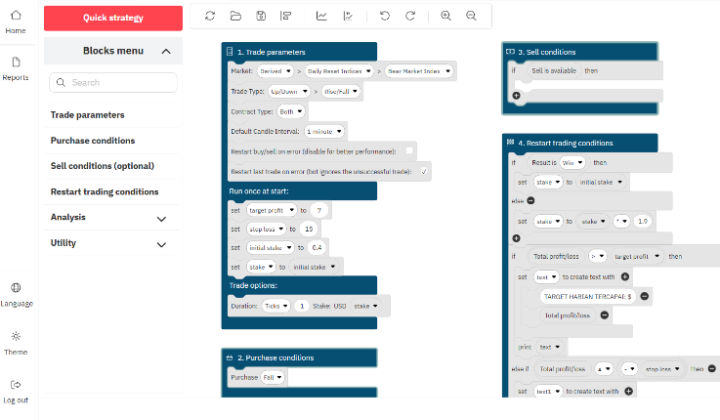
Building a bot on Deriv doesn’t require a computer science degree. It’s all about connecting blocks, like digital LEGOs. Here is how I set up the logic for a standard Bollinger Band approach.
Step 1: Defining the Parameters
First, you need to head over to the “Variables” tab in DBot. You’ll want to create variables for your Stake, your Take Profit, and your Stop Loss. But most importantly, you need a variable for the Bollinger Band period and deviation. Traditionally, a 20-period moving average with a standard deviation of 2 is the sweet spot. In 2026, I find that a 14-period setting works slightly better for the faster-paced synthetic indices on Deriv, as it reacts more quickly to sudden shifts.
Step 2: The Logic Block
This is where the magic happens. You’ll go to the “Analysis” section and find the Bollinger Bands block. You want the bot to look at the ‘Last Tick’ or the ‘Close’ of the previous candle. The logic goes like this: If the current price is less than or equal to the Lower Band, it’s time to buy (Rise). If the current price is greater than or equal to the Upper Band, it’s time to sell (Fall).
Step 3: The Purchase Block
You don’t want the bot buying every single millisecond the price touches a band. That’s a one-way ticket to an empty account. I always add a ‘Wait’ block or a condition that ensures the bot only places one trade per candle. This keeps the bollinger bands dbot strategy deriv clean and prevents the bot from spamming trades during a massive breakout.
The Myth of the “Perfect” Bot
Let’s be real for a second. I’ve seen countless YouTube videos claiming their DBot strategy has a “99% win rate.” That’s nonsense. If it were true, they wouldn’t be selling you a course; they’d be on a private island with a cocktail in hand. The reality of using the bollinger bands dbot strategy deriv is that it works beautifully in ranging markets, but it can get shredded during a strong trend.
Imagine the price hits the upper band, and your bot sells. But then, a major news event or a massive whale buy-in happens. The price keeps hugging that upper band, moving higher and higher while your bot keeps trying to sell. This is called “walking the bands.” To survive this, your strategy needs a filter. I often pair my Bollinger Bands with a Relative Strength Index (RSI). If the price touches the upper band AND the RSI is over 70, the signal is much stronger than just the band touch alone.
Risk Management: The Heart of the System
You can have the best entry logic in the world, but if your risk management is trash, your bot will fail. This is the part of the bollinger bands dbot strategy deriv that most people ignore because it’s not as “exciting” as the entry signals.
In 2026, the volatility in synthetic indices like Volatility 100 (1s) can be staggering. I’ve learned the hard way that a simple Martingale (doubling your stake after a loss) is incredibly dangerous. Instead, I prefer a “Split Martingale” or a simple flat-betting system until I hit a certain drawdown percentage. Your DBot should have a hard “Stop Loss” block that kills the script entirely if you lose more than, say, 10% of your balance in a single session. Protect your capital first; the profits will come later.
Fine-Tuning for Different Market Conditions
Not all market conditions are created equal. When you are running your bollinger bands dbot strategy deriv, you need to recognize the environment.
- The Squeeze: When the bands get very narrow, it means a breakout is coming. I usually pause my bot during a squeeze because the bands aren’t providing reliable support or resistance levels.
- The Expansion: After a squeeze, the bands will flare out. This is where trend-following bots shine, but our mean-reversion bot needs to be careful. I wait for the bands to start curving back inward before I let the bot resume trading.
- The Night Owl: Many traders find that certain synthetic indices behave more predictably during specific hours. Even though Deriv is 24/7, I’ve noticed my Bollinger Band bot performs best during periods of lower global volume when the “mean-reverting” behavior is more common.
The Human Element in Automated Trading
There’s a common misconception that once you finish your bollinger bands dbot strategy deriv setup, you never have to look at it again. That’s a mistake. I treat my bots like employees. I check in on them. I look at their performance logs at the end of the day. If the market is acting weird—maybe there’s a global liquidity crisis or a massive platform update—I pull the plug for a bit.
The most successful traders I know in 2026 aren’t the ones with the most complex code; they are the ones with the most discipline. They know when to let the bot run and when to step in. Automation is a tool to leverage your time, not a replacement for your brain.
Why Deriv’s DBot is the Right Platform
I’ve tried other platforms, and honestly, most of them are either too simple to be useful or so complex you need to be a C++ developer to use them. Deriv strikes a balance. The DBot interface allows you to visualize the logic. You can see the flow of data from the market through your indicators and into the trade execution. Plus, the ability to run the bollinger bands dbot strategy deriv on a virtual account indefinitely is a lifesaver. I never run a new tweak on a real account until it has survived at least 1,000 trades in the virtual environment. If it can’t survive a week of simulation, it has no business touching my hard-earned money.
Common Pitfalls to Avoid
If you’re just starting out with the bollinger bands dbot strategy deriv, watch out for these traps:
- Over-Optimization: It’s tempting to tweak the settings until the backtest looks like a straight line up. This is called curve-fitting. Usually, a bot that is too perfectly tuned to the past will fail miserably in the future. Keep your settings simple.
- Ignoring the Spread: On some assets, the gap between the buy and sell price can eat your profits if your bot trades too frequently. Ensure your strategy accounts for this cost.
- Emotional Intervention: Paradoxically, the biggest risk to a bot is the human running it. I’ve seen people see two losses in a row, panic, and change the settings mid-run. This breaks the statistical edge of the strategy. Trust your math or don’t run the bot at all.
A Look into the Future of DBot Trading
As we move through 2026, I expect to see even more integration between AI-driven sentiment analysis and these classic technical strategies. We might soon see blocks in DBot that allow us to filter our bollinger bands dbot strategy deriv based on real-time news feeds or social media volatility. But for now, the core principles of price action and volatility remain the most reliable pillars for any automated system.
Trading is a journey, not a destination. Transitioning from a manual trader to someone who manages a fleet of bots was the best decision I ever made for my mental health and my bank account. It wasn’t easy, and there were plenty of “back to the drawing board” moments, but the freedom it provides is worth every hour spent debugging blocks and testing theories.
Final Thoughts for the Aspiring Bot Builder
Don’t be intimidated by the technical side of things. Start small. Build a basic version of the bollinger bands dbot strategy deriv, run it on a demo account, and just watch how it behaves. Observe how it reacts when the market spikes. Learn its weaknesses. Once you understand where it fails, you can build the protections it needs to succeed. Automation is a marathon, not a sprint. Take your time, manage your risk, and let the bands do the heavy lifting for you.