The Moment Your Account Balance Holds Its Breath
Imagine this: You are sitting in your favorite coffee shop, the steam from your latte catching the morning light. You open your laptop or phone, and there it is—a perfect setup on the Volatility 75 Index. The trend line is holding, the RSI is screaming ‘buy,’ and your gut says this is the big one. You want to jump in with a significant lot size because you’re feeling confident. But then, a tiny voice in the back of your head whispers, “Can your account actually handle this trade?”
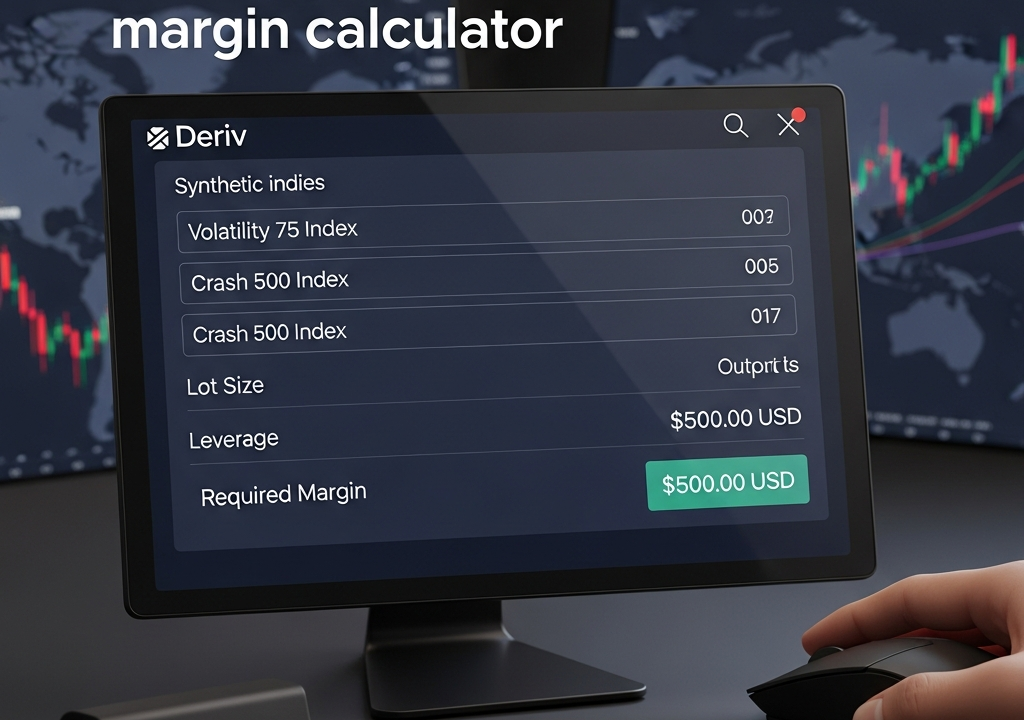
Most traders, especially when they are starting out, treat their account balance like a bottomless pit until that dreaded ‘Margin Call’ notification pops up. It’s a gut-wrenching feeling. You see your positions being closed automatically by the broker, not because you were wrong about the direction, but because you didn’t have enough ‘gas in the tank’ to survive the minor fluctuations. This is exactly where the Deriv synthetic indices margin calculator becomes more than just a tool; it becomes your emotional stabilizer and financial bodyguard.
In 2026, the markets move faster than ever. Synthetic indices, which are generated by cryptographically secure algorithms, simulate real-world market movements but operate 24/7. Because they don’t sleep, you can’t afford to be sloppy with your math. Using a Deriv synthetic indices margin calculator isn’t just about following rules—it’s about staying in the game long enough to actually win.
What is Margin, Really?
Before we dive into the nuts and bolts of the calculator, let’s talk about what margin actually represents. Think of margin as a security deposit. When you want to control a large position in the market (say, $10,000 worth of an index) but you only have $500 in your account, the broker lets you ‘borrow’ the rest of the purchasing power. The margin is the portion of your own money that the broker ‘locks’ to ensure you can cover potential losses.
If you’re trading Volatility indices, Crash/Boom, or Jump indices, each one has its own personality. Some are like a steady walk in the park; others are like a rollercoaster with the brakes cut. The amount of money you need to hold a position varies wildly between them. Without the Deriv synthetic indices margin calculator, you’re essentially trying to do complex calculus in your head while your adrenaline is spiking. That’s a recipe for disaster.
Why Synthetic Indices Need a Specific Calculator
You might wonder, “Can’t I just use a standard Forex margin calculator?” The short answer is no. Synthetic indices have unique contract sizes and leverage structures that differ from EUR/USD or Gold. For instance, the way a ‘point’ is calculated in the Step Index is completely different from how it works in Volatility 10 (1s). The Deriv synthetic indices margin calculator is specifically calibrated to the proprietary algorithms used by Deriv. It takes into account the exact specifications of each index, ensuring that the number you see on your screen is the number that actually matters for your MT5 account.
How to Use the Deriv Synthetic Indices Margin Calculator Like a Pro
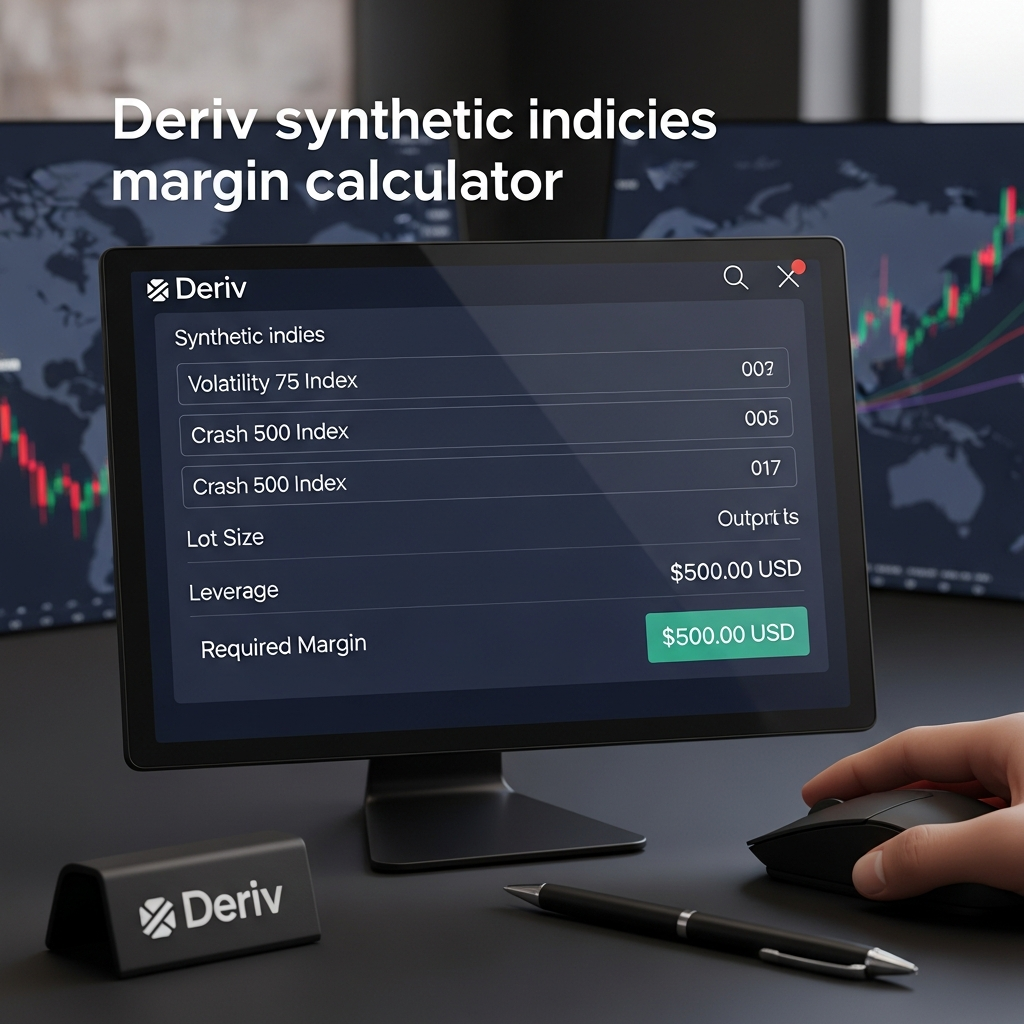
Using the tool is straightforward, but garbage in equals garbage out. You need to know what data to feed it to get an accurate result. Here’s a breakdown of the typical workflow I use every single morning before I place a single trade.
- Select Your Asset: Start by picking the specific index. Are you trading the Boom 1000? Or perhaps the newer 2026 variants of the Volatility series? Each has a different contract size.
- Input Your Leverage: Deriv offers various leverage levels, often up to 1:1000 for certain accounts. Remember, higher leverage means lower margin requirement, but it also means your account can vanish faster if things go south.
- Define Your Lot Size: This is where most people trip up. On synthetic indices, a 0.10 lot on one index might be worth pennies, while on another, it could be worth hundreds of dollars per point.
- Check the Required Margin: Once you hit calculate, the tool tells you exactly how much of your balance will be tied up.
I always recommend leaving at least 60-70% of your equity ‘free.’ If the Deriv synthetic indices margin calculator tells you that a trade will take up $40 of your $100 account, you’re over-leveraged. One small spike in a Crash index and you’re toast.

The Hidden Dangers of “Eyeballing” Your Risk
I remember a friend of mine, let’s call him Mark. Mark was a great technical analyst. He could spot a head-and-shoulders pattern from a mile away. One Tuesday, he decided to trade the Volatility 100 index. He thought he knew the margin requirements by heart because he had been trading Volatility 10. He opened a 1.0 lot position, thinking his $2,000 account could handle a bit of a drawdown.
What Mark forgot was that Volatility 100 is significantly more ‘expensive’ in terms of margin and point value than Volatility 10. Within three minutes, the market moved slightly against him. It wasn’t even a big move. But because his margin was stretched to the limit, his ‘Margin Level Percentage’ dropped below the stop-out level. His trade closed automatically at a massive loss. If he had used the Deriv synthetic indices margin calculator, he would have seen that his 1.0 lot was actually 10 times larger than what his risk management plan allowed.
This is the reality of the markets in 2026. The volatility is beautiful for making profits, but it is unforgiving to the unprepared. The calculator isn’t just a math tool; it’s a ‘sanity check.’
Advanced Strategy: Working Backwards
Most traders use the calculator to see if they *can* afford a trade. Professional traders use it to decide *how much* they should trade. This is called ‘Position Sizing,’ and it’s the secret sauce of everyone who survives more than a year in this business.
Instead of saying “I want to trade 0.5 lots,” try this: “I am willing to risk $20 on this trade. Based on my stop loss distance, what lot size allows me to only lose $20?” You can use the Deriv synthetic indices margin calculator in conjunction with your stop-loss pips to find that ‘sweet spot.’ This way, you are never surprised by the outcome. If you hit your stop loss, you lose exactly what you planned. If the trade goes your way, you know your margin was safe the whole time.
The Psychology of knowing Your Numbers
There is a massive psychological benefit to using the Deriv synthetic indices margin calculator. Trading is stressful enough. When you are in a trade and the price starts moving against you, your brain starts playing tricks. You begin to panic, wondering if you’re about to lose everything. However, if you’ve done the math beforehand, you can stay calm. You know exactly where your breaking point is. You’ve seen the numbers. This clarity allows you to hold through the ‘noise’ and wait for your take-profit to be hit.
Common Questions About Synthetic Margin
I get asked a lot about the ‘Free Margin’ vs. ‘Used Margin’ display on MT5. Your used margin is what the Deriv synthetic indices margin calculator helps you predict. Your free margin is what you have left to open *new* trades or to soak up losses from current ones. In 2026, with the introduction of more complex derivative products on the Deriv platform, keeping a close eye on these numbers is non-negotiable.
Another common query is about leverage changes. Sometimes, during periods of extreme market stress or platform updates, leverage might be adjusted. Always re-run your numbers through the Deriv synthetic indices margin calculator if you notice any changes in your account settings. Never assume the parameters from last month are the same today.
The 2026 Trading Landscape
The world of synthetic trading has evolved. We now have indices that mimic high-frequency trading environments and even those that simulate sector-specific economic shifts. The complexity has increased, but so have the tools. The Deriv synthetic indices margin calculator is now integrated with more features, sometimes even allowing for ‘what-if’ scenarios where you can simulate a market spike to see if your margin would hold.
We’re seeing a lot more retail traders moving away from traditional currencies and into synthetics because of the lack of geopolitical interference. A tweet from a world leader isn’t going to gap the Volatility 75 index. It’s pure technical movement. But that purity requires pure mathematical discipline. You are trading against an algorithm; you should use a tool that understands that algorithm’s requirements.
Final Thoughts for the Disciplined Trader
If you’re serious about making a living—or even just a consistent side hustle—from trading, you have to treat it like a business. No business owner survives without knowing their overhead and their costs. In the trading world, margin is your cost of doing business. The Deriv synthetic indices margin calculator is your accounting software.
Don’t be the trader who looks back at a blown account and says, “I wish I knew how much that position was going to cost me.” Be the trader who spends sixty seconds before every trade checking the calculator. It might feel like a chore at first, but soon it will become as natural as breathing. Those sixty seconds are the difference between a long, successful trading career and a short, expensive lesson.
Take control of your risk today. Open up the Deriv synthetic indices margin calculator, plug in your favorite index, and see how your current strategy measures up. You might find that you’ve been risking way too much—or perhaps, you’ll find you have the room to safely scale up. Either way, knowledge is power, and in the markets, power is profit.