
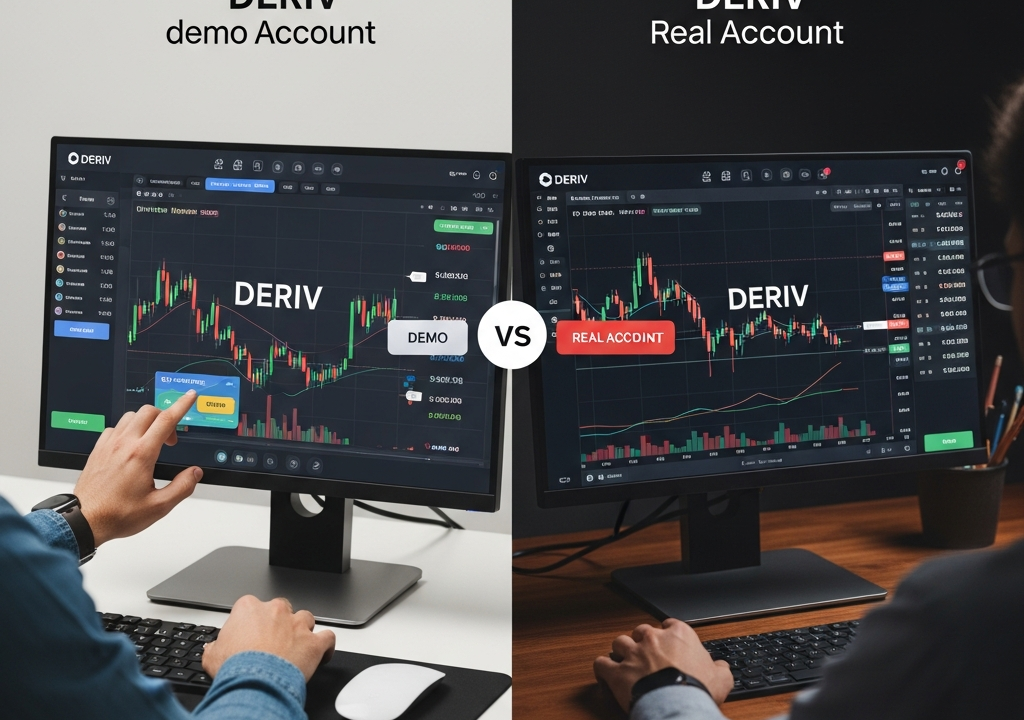
The Great Leap: Why Moving to Live Trading Feels So Different
You have been crushing it on the virtual charts for weeks. Your balance is up 20%, your strategies seem bulletproof, and you feel like the next big thing in the trading world. But then, you open a live account, deposit your hard-earned cash, and suddenly, everything feels wrong. The numbers move differently, your heart beats faster, and those ‘guaranteed’ setups start failing. This isn’t just bad luck. It is the result of the fundamental Deriv demo account vs real account differences that every trader must master to survive.
In 2026, the trading landscape has evolved with faster execution and smarter tools, but the gap between practice and reality remains the steepest mountain to climb. Whether you are trading synthetic indices, forex, or commodities on Deriv, understanding these nuances is the difference between a growing portfolio and a blown account. Let’s pull back the curtain on what actually happens when you flip the switch from ‘practice’ to ‘live’.

Breaking Down the Technical Deriv demo account vs real account differences
On the surface, the Deriv interface looks identical whether you are using virtual funds or real USD. However, under the hood, the mechanics of how your trades are processed can vary significantly. While Deriv strives to make the demo environment as realistic as possible, a simulation can never perfectly replicate a live global market.
Execution Speed and Order Filling
In a demo environment, your trades are executed against a computer algorithm that essentially says “yes” to every request instantly. If you want to buy 10 lots of Volatility 75 at a specific price, the demo server grants it immediately. In the real world, however, every ‘buy’ needs a ‘seller’. While Deriv’s liquidity is deep, especially for their proprietary synthetic indices, there can still be micro-seconds of delay as your order is matched in the live market. This lead-time, however small, can impact your entry price.
The Reality of Slippage
Slippage is a term that demo traders rarely encounter. It happens when you click ‘buy’ at 1.2000, but the trade actually opens at 1.2005 because the price moved faster than the system could process your order. In a demo account, slippage is often non-existent because there is no real-world liquidity constraint. When you move to a real account, especially during high-volatility news events or market opens, slippage becomes a very real factor that can eat into your profit margins.
Requotes and Market Gaps
Have you ever seen the price ‘jump’ over your Stop Loss during a weekend or a major news break? In a demo account, these gaps are sometimes smoothed out. In a live account, if the market gaps past your price, your order might be filled at the next available price, which could be much worse than your intended exit. This is one of the most jarring Deriv demo account vs real account differences for beginners who assume their Stop Loss is a physical barrier that cannot be crossed.
The “Demo Hero” Syndrome: Why Your Brain Lies to You
The biggest difference isn’t actually in the software; it’s in the six inches between your ears. Trading with ‘monopoly money’ allows you to be fearless. You can hold a losing trade for three days without breaking a sweat because there is no real consequence. This builds a false sense of confidence.
When real money is on the line, your brain’s amygdala takes over. This is the part of the brain responsible for the fight-or-flight response. Suddenly, a $5 drawdown feels like a personal attack. You might find yourself closing winning trades too early because you are afraid of losing the small profit you have, or holding onto losers far too long, hoping they will turn around so you don’t have to face the ‘real’ loss.
I remember a trader friend who traded the Deriv Volatility 100 index for three months on demo. He turned $10,000 into $50,000. He felt like a god. On his first day with a real $1,000 account, he lost $400 in two hours. Why? Because he couldn’t handle the physiological stress of seeing his grocery money fluctuate. He over-leveraged to ‘win back’ a $20 loss, and the spiral began.
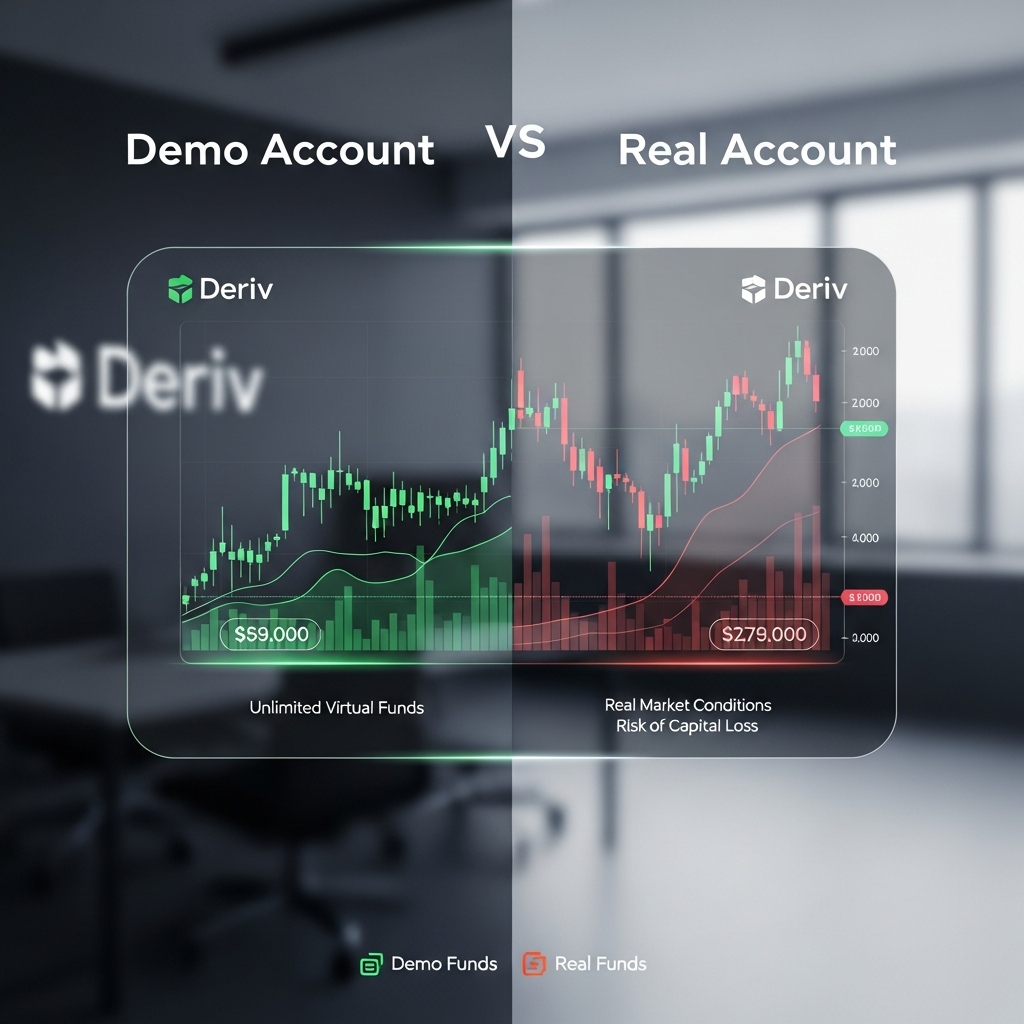
Asset Availability and Account Types in 2026
Deriv offers a variety of account types, including the Financial account (for Forex and Commodities) and the Derived account (for Synthetics). One of the Deriv demo account vs real account differences involves how these assets behave during specific hours.
- Synthetic Indices: These are available 24/7 and behave almost identically on demo and real accounts because they are governed by a transparent algorithm. This makes them a favorite for those transitioning to live trading.
- Financial Markets: Forex pairs and stocks are subject to global bank hours. Spreads (the difference between the buy and sell price) can widen significantly on a real account during the ‘dead hours’ between the New York close and the Tokyo open. You might not notice this on demo, but on a real account, a wide spread can trigger your stop loss before the trade even has a chance to move in your direction.
The Hidden Impact of Spreads and Commissions
When you are trading on a demo account, you often ignore the ‘cost of doing business’. A 2-pip spread feels like nothing when you have $10,000 in play-money. But when you are starting a real account with $100, that spread represents a larger percentage of your equity. Beginners often overlook how these costs stack up. In a live environment, you start every trade in the ‘red’ (negative) due to the spread. Learning to manage this small psychological hurdle is a vital part of the transition.
Practical Tips for a Smooth Transition
Now that we have identified the Deriv demo account vs real account differences, how do you bridge the gap without losing your shirt? Here is a roadmap for 2026 traders:
1. Start Small, Not Big
Don’t jump from a $10,000 demo account to a $10,000 real account. The psychological weight will be too much. Start with a ‘cent’ account or a small deposit of $100. Trade the smallest possible lot sizes. The goal isn’t to get rich in the first week; the goal is to get used to the feeling of real money moving.
2. Treat Demo Like Reality
If you wouldn’t risk $5,000 on a single trade in real life, don’t do it on your demo account. Practice disciplined risk management from day one. If your demo account has $10,000 but you only plan to deposit $500 of real money, ask Deriv support to reset your demo balance to $500. This makes the experience much more authentic.
3. Keep a Trading Journal
Note down your emotions. Were you sweating? Did you close the trade because the strategy told you to, or because you were scared? Comparing your demo journal to your live journal will highlight exactly where your psychological weaknesses lie.
4. Focus on Process, Not Profits
In the demo world, we focus on the final balance. In the real world, you must focus on the execution. Did you follow your rules? If you followed your rules and lost money, that is a ‘good’ trade. If you broke your rules and made money, that is a ‘bad’ trade because you are building habits that will eventually lead to a massive loss.
The Role of Automated Tools and EAs in 2026
With the rise of AI-driven trading tools on Deriv, many traders use Expert Advisors (EAs) or bots to bridge the gap. Bots don’t have emotions, which solves the ‘Demo Hero’ problem. However, bots are still subject to the technical Deriv demo account vs real account differences like slippage and latency. A bot that performs perfectly on a demo feed might struggle on a live feed if its strategy relies on ultra-fast scalping. Always backtest and ‘forward-test’ bots on a small live account before giving them full control of your capital.
Managing Your Expectations: A Reality Check
It is perfectly normal to see a slight dip in your performance when you first move to a real account. Expect it. Give yourself grace. The market is the most expensive classroom in the world, and your initial losses are simply the ‘tuition’ you pay to learn the craft.
The platform is a tool, but you are the pilot. By acknowledging that a real account has liquidity constraints, slippage, and a massive psychological weight, you are already ahead of 90% of retail traders who rush in blindly. Respect the differences, start small, and stay patient. The markets aren’t going anywhere, and your path to consistency is a marathon, not a sprint.
Final Thoughts for the Modern Trader
The journey from a Deriv demo account to a real account is a rite of passage. It marks the transition from a hobbyist to a serious participant in the global economy. By understanding that the differences are both technical and emotional, you can prepare yourself for the challenges ahead. Remember, the goal of a demo account is to learn the interface and the strategy, but the goal of a real account is to master yourself. Take it one trade at a time, keep your risk low, and stay focused on the long-term vision of your 2026 trading goals.