The Great Trading Dilemma: Choosing Your Weapon
Picture this: It is a Tuesday morning in 2026. You are sitting at your favorite coffee shop, looking at a volatile spike in the Volatility 100 (1s) Index. You have a solid hunch that the price is about to bounce. You open your Deriv app, and you are faced with a choice that every trader has wrestled with at some point. Do you go with the traditional leverage of a CFDs account, or do you opt for the newer, sleeker multipliers? This choice defines your entire trading experience, your potential profit, and—perhaps most importantly—how well you will sleep tonight.
The debate of Deriv multipliers vs leverage is not just about math; it is about your personality as a trader. Some people love the raw power and complexity of leverage, while others prefer the capped-risk simplicity of multipliers. To make the right call, we need to peel back the layers and look at what is actually happening under the hood of these two financial engines.

Understanding the Old Guard: What Is Leverage?
Leverage has been the backbone of retail trading for decades. If you have ever used MT5, you have used leverage. In simple terms, leverage allows you to control a large position with a relatively small amount of money. Think of it like a mortgage. You put down a small deposit (margin), and the broker lends you the rest to control a huge asset.
When you trade with a 1:100 leverage, for every $1 you put up, you are controlling $100 in the market. This is exhilarating when the market moves in your favor because your $10 profit becomes $1,000. But let’s be real for a second. The dark side of leverage is what ruins most beginners. If the market moves against you by even a tiny percentage, that same 1:100 ratio works against you. Your margin evaporates, and you hit a margin call faster than you can say “stop loss.”
In the world of 2026 trading, leverage remains the tool of choice for those who want to execute complex strategies, use expert advisors (EAs), and manage multiple positions simultaneously. It is highly flexible, but it demands constant vigilance. You are responsible for setting your own stops, managing your margin levels, and ensuring you don’t get wiped out by a sudden gap in the market.
The New Contender: What Are Multipliers?
Then we have multipliers, Deriv’s unique take on the trading world. If leverage is a high-performance manual sports car, multipliers are the high-tech electric vehicle with built-in safety sensors. Multipliers allow you to amplify your potential profit without the risk of losing more than your initial stake. It is a hybrid between options trading and spot trading.
When you trade with a multiplier, you choose your stake (say $100) and a multiplier value (like x500). If the market goes up by 1%, your profit is increased by 500%. However, here is the kicker: your potential loss is strictly limited to your $100 stake. Even if the market crashes 50% in a second, you can never lose more than that original $100. There is no such thing as a negative balance with multipliers.
This “limited risk” feature is a game-changer for many. It takes the psychological pressure off. You don’t have to worry about your whole account being liquidated because of one bad trade. You know exactly what you are risking the moment you click “Buy” or “Sell.”
Direct Comparison: Deriv Multipliers vs Leverage
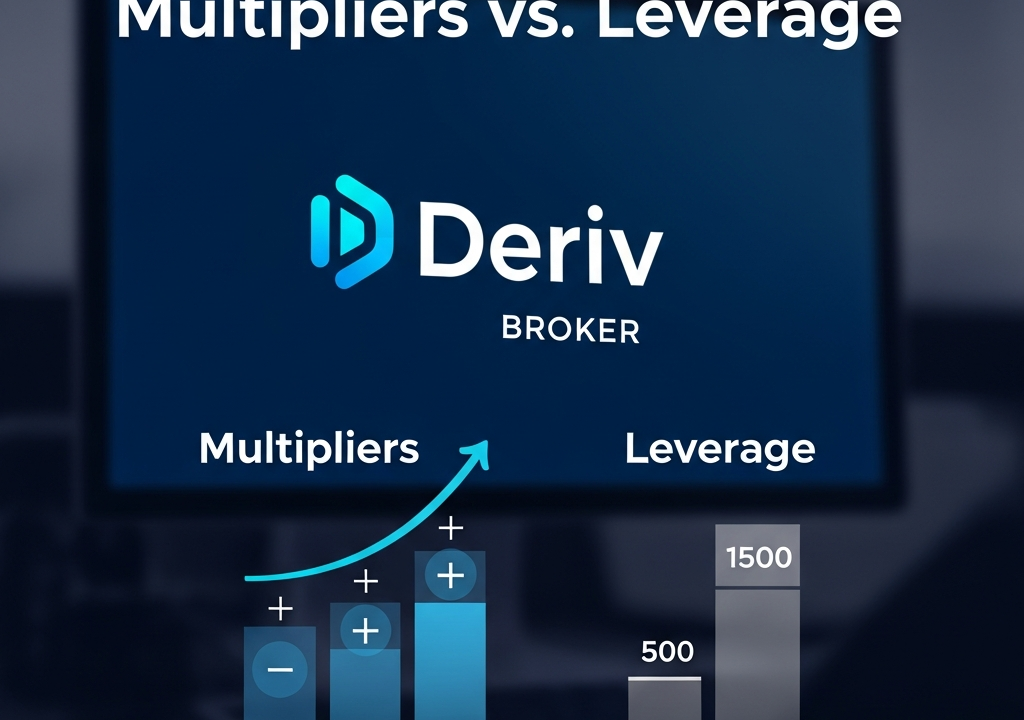
When we look at Deriv multipliers vs leverage head-to-head, several key differences emerge that can change your daily trading routine. Let’s break them down into the categories that actually matter to your wallet.
1. Risk Management and the Safety Net
In leverage trading, you are essentially juggling fire. If you forget to set a stop loss, or if the market gaps past your stop loss during a high-impact news event, you could lose significantly more than you intended. While Deriv offers negative balance protection on many accounts, the volatility can still be gut-wrenching.
Multipliers, on the other hand, have a built-in “automatic stop-out.” If the market moves against you to the point where your loss equals your stake, the trade closes automatically. You can’t “accidentally” lose your whole account on a single multiplier trade unless you bet your whole account as the stake (which you should never do!). This makes multipliers much more friendly for those who might get emotional or forgetful in the heat of the moment.
2. Cost and Fees
This is where things get interesting. In leverage trading (CFDs), you usually deal with spreads and swaps (overnight fees). If you hold a position open for three days, you are going to pay for it. Depending on the asset, these costs can eat into your profits.
Multipliers also have costs, but they are structured differently. You pay a commission when you open the trade. For some, this feels more transparent. However, if you are planning to hold a trade for a very long time, you need to check the specific multiplier conditions for that asset, as some have daily maintenance charges. Generally, for quick intraday scalping, both are competitive, but multipliers feel a bit more “pay-as-you-go.”

3. Control and Flexibility
Leverage wins the flexibility round. When you trade CFDs with leverage on a platform like MT5, you have total control over your position size down to the micro-lot. You can scale into positions, partially close a trade to lock in profits, and use advanced order types. You can also run automated bots that manage everything for you.
Multipliers are a bit more rigid. Once you set your stake and multiplier, the trade is what it is. You can set a “Take Profit” and a “Stop Loss” (which acts as an additional safety layer before the automatic stop-out), and you can even use a “Cancel Trade” feature (for a small fee) that lets you get your money back if the trade goes south within a few minutes. This “Cancel Trade” feature is something you simply don’t get with traditional leverage, and it’s a massive advantage in 2026’s hyper-volatile markets.
Which One Should You Choose?
Deciding between Deriv multipliers vs leverage depends on your goals. Let’s look at a few scenarios that might sound familiar.
The “Set and Forget” Trader
If you have a full-time job and you want to catch a move on the EUR/USD or a synthetic index without staring at your phone all day, multipliers are likely your best friend. You can put down a $50 stake, set a multiplier, and know that even if the world ends, you only lost $50. You don’t have to worry about margin calls or complex lot size calculations. It’s clean, simple, and effective.
The Professional Scalper
If you are a seasoned pro who spends hours in front of four monitors, analyzing order flow and using specialized software, you will probably stick with leverage. The ability to use MT5, customize your risk to the penny, and execute trades in milliseconds is vital for high-frequency strategies. Leverage allows for a level of precision that multipliers don’t quite match.
The Crypto Enthusiast
In 2026, crypto remains as wild as ever. Trading Bitcoin or Ethereum with high leverage is a recipe for a heart attack. Multipliers are a fantastic way to trade crypto because they protect you from the “wick”—those sudden, violent price spikes that hunt stop losses in leveraged accounts. Since your loss is capped at your stake, a temporary spike against you won’t necessarily wipe out your entire account balance.
The Psychological Factor: Trading Without Fear
Let’s talk about the elephant in the room: fear. Most traders fail not because their strategy is bad, but because they can’t handle the emotions of losing money. When you trade with leverage, seeing your “Free Margin” drop toward zero is terrifying. It leads to bad decisions, like “revenge trading” or moving your stop loss further away in hopes the market will turn around.
The Deriv multipliers vs leverage debate often ends here for many beginners. Multipliers eliminate the fear of the unknown. When you know your maximum loss from the second you enter the trade, your brain stays in “logic mode” rather than “panic mode.” This psychological safety is worth more than any technical indicator. It allows you to focus on the chart rather than your balance.
Strategic Combinations: Why Not Both?
Many successful traders in 2026 don’t actually choose just one. They use a “barbell strategy.” They might keep the bulk of their capital in a leveraged CFD account for low-volatility, long-term trades where they can carefully manage margin. Then, they use a separate portion of their funds for high-stakes, high-volatility opportunities using multipliers.
For example, during a major economic announcement, you might use a multiplier trade. Why? Because the spread widening and slippage on a leveraged account during news can be catastrophic. With a multiplier, your risk is fixed regardless of how messy the market gets. It is essentially using the right tool for the right job.
Common Pitfalls to Avoid
Whether you choose Deriv multipliers vs leverage, there are traps you need to dodge. In leverage, the biggest trap is over-leveraging—using a 1:1000 ratio just because it’s available. It is like driving a car at 200mph; just because the speedometer goes that high doesn’t mean it’s a good idea.
In multipliers, the trap is the “gambler’s fallacy.” Because it feels like you are just placing a small stake, it’s easy to treat it like a bet rather than a trade. You might find yourself clicking “Up” or “Down” repeatedly without a real strategy. Always remember: a multiplier trade is still a market position. It requires analysis, trend identification, and discipline.
Final Thoughts for the Modern Trader
As we navigate the markets of 2026, the tools at our disposal are better than they have ever been. Deriv has bridged the gap between professional-grade financial instruments and user-friendly interfaces. The choice of Deriv multipliers vs leverage isn’t about which one is “better” in a vacuum. It is about which one is better for *you* right now.
If you value precision, automation, and are comfortable managing margin, leverage on MT5 is your path. If you value peace of mind, fixed risk, and simplicity, multipliers on DTrader are likely where you will thrive. The most important thing is to understand the mechanics of whichever tool you pick. Spend some time on a demo account, feel the difference in how your heart rate reacts to a price move, and then make your choice with a clear head.
Trading is a marathon, not a sprint. Whether you are multiplying your gains or leveraging your capital, the goal is to stay in the game long enough to see your edge play out. Choose wisely, manage your risk, and stay disciplined. The market isn’t going anywhere, and with the right approach, neither are you.