
The Great Trading Dilemma of 2026
It usually happens around 2:00 AM. You are sitting there with three monitors glowing, a half-empty cup of cold coffee, and a burning desire to finally master the markets. You have narrowed your choices down to two heavyweights, but you are stuck. This Deriv vs Pocket Option comparison isn’t just about looking at a list of features; it is about finding out which platform actually feels right when your hard-earned money is on the line.
I remember when I first started trading. I spent weeks jumping between demo accounts, trying to figure out why one platform felt like a professional trading desk while the other felt more like a high-stakes video game. Both have evolved massively as we move through 2026, integrating better AI-driven insights and lightning-fast execution. But they serve very different types of traders. Let’s peel back the layers and see what’s actually happening under the hood.
The Heritage Factor: Where Do They Come From?
Before we dive into the technical specs, we have to look at the DNA of these companies. Deriv is the rebranded evolution of Binary.com, a name that has been around since the late 90s. They have survived every market crash, every regulatory shift, and every technological revolution of the last quarter-century. When you trade on Deriv, you are trading on a foundation that has been battle-tested for decades.
Pocket Option, on the other hand, is the disruptor. They arrived on the scene much later, around 2017, and they didn’t try to be a traditional broker. They leaned hard into the user experience, social features, and a “fun” vibe that lowered the barrier to entry for retail traders. If Deriv is the seasoned professor of the trading world, Pocket Option is the tech-savvy entrepreneur who knows exactly what the modern crowd wants.
Platform Experience: Function vs. Flair
The first thing you notice when you log into Deriv is the cleanliness. It is professional, almost surgical. They offer a suite of platforms: DTrader for simplicity, SmartTrader for the old-school binary feel, and the heavy hitters like MT5 (MetaTrader 5) and Deriv X for those who want to do deep technical analysis. In 2026, their integration of MT5 remains the gold standard for traders who use Expert Advisors (EAs) or custom indicators.
Pocket Option takes a different route. Their primary web platform is an all-in-one powerhouse. You don’t need to download five different apps to get the full experience. Everything—charts, social trading feeds, signals, and your history—is right there on one screen. It is vibrant, colorful, and highly interactive. For a beginner, Pocket Option feels much less intimidating. For a pro, the lack of a native MT5 connection for binary trades might be a slight turn-off, though they have bridged many of those gaps recently.
The Social Trading Revolution
If you love the idea of watching what other people are doing, this is where our Deriv vs Pocket Option comparison takes a sharp turn. Pocket Option is the undisputed king of social trading. You can literally scroll through a leaderboard of the most successful traders on the platform, see their win rates, and click a button to copy their trades automatically. It creates a sense of community that is often missing in the lonely world of day trading.
Deriv is much more focused on the individual. While they have tools for automated trading (like Dbot, which is fantastic for building your own logic without knowing how to code), they don’t really push the “social” aspect. Deriv assumes you want to build your own strategy and execute it quietly. It is a more solitary experience, but for many, that leads to better discipline.
Market Assets: What Can You Actually Trade?
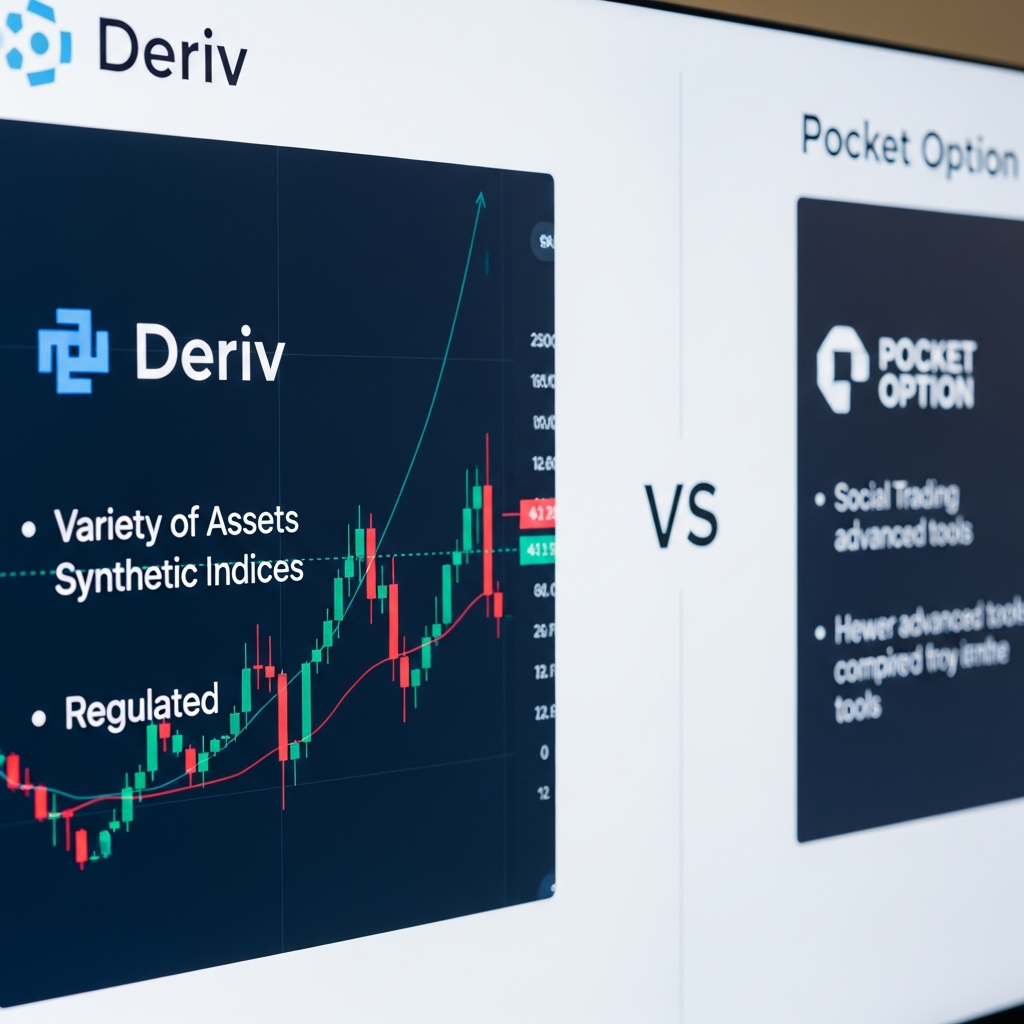
This is usually the dealbreaker for most people. Deriv has a secret weapon that no one else has quite replicated: Synthetic Indices. These are markets that are proprietary to Deriv, simulated by a cryptographically secure random number generator. The beauty of these is that they are not affected by real-world news. If there is a political crisis or a central bank meeting, the Volatility 75 index on Deriv doesn’t care. It trades 24/7, 365 days a year, with constant liquidity. For those who trade on weekends, Deriv is a paradise.
Pocket Option counters this with a massive variety of real-world assets. Their selection of OTC (Over-The-Counter) pairs for weekend trading is extensive, and they offer a huge range of stocks, commodities, and cryptocurrencies. If you want to trade the price movement of Apple or Tesla at 10 PM on a Sunday, Pocket Option usually has a chart ready for you with high payout percentages.
Payouts and Percentages
- Pocket Option: Frequently offers payouts as high as 92% to 96% on popular currency pairs. They also have a “gems” and “xp” system where you can buy risk-free trades or payout boosters.
- Deriv: Payouts are dynamic. While they might not always hit those 95% peaks seen on Pocket Option, their pricing is often more transparent, and the “multiplier” accounts offer a unique way to limit risk while maximizing profit potential without the “all or nothing” nature of traditional binaries.
Deposits, Withdrawals, and the Trust Factor
Let’s talk about the elephant in the room: getting your money out. In 2026, crypto is the standard, and both platforms handle it well. Whether you are using USDT, Bitcoin, or Ethereum, transactions are usually processed within a few hours.
Deriv has a massive advantage in terms of regulation. They hold licenses in multiple jurisdictions, including Malta, Labuan, and the British Virgin Islands. This regulatory oversight provides a layer of security that makes high-net-worth traders feel a lot more comfortable. If you are planning to deposit five or six figures, Deriv is generally the safer bet.
Pocket Option operates primarily under an IFMRRC certificate. While they have a stellar reputation for paying out quickly—I’ve personally never had an issue getting a withdrawal processed within 24 hours—they don’t have the same level of top-tier government licensing that Deriv boasts. They make up for this with incredible flexibility in payment methods, often supporting local e-wallets and bank transfers in regions where other brokers struggle.
The “Hidden” Features You Need to Know
In any Deriv vs Pocket Option comparison, you have to look at the tools that help you stay in the game. Pocket Option includes a built-in “Signals” service. It tells you “Strong Buy” or “Strong Sell” based on various indicators. Are they 100% accurate? No. Nothing is. But for a quick second opinion, they are quite handy.
Deriv offers the “Deriv Go” app, which is one of the smoothest mobile trading experiences I have used in 2026. It is designed specifically for their Multipliers product, which is a hybrid between Forex and Options. It allows you to set a stop loss and take profit, ensuring you never lose more than your initial stake, but with the leverage to make significant gains. It is a brilliant middle ground for people who find binary options too risky but find traditional Forex too complicated.
Which One Should You Choose?
It really comes down to your personality as a trader. There is no “perfect” broker, only the one that aligns with your strategy and your risk tolerance.
Choose Deriv if:
- You want to trade Synthetic Indices (Boom/Crash, Volatility) that are available 24/7.
- You prefer a professional, minimalist interface and access to MT5.
- You value long-term regulatory history and multiple licenses.
- You want to build complex trading bots using a visual drag-and-drop interface.
Choose Pocket Option if:
- You want to copy the trades of successful pros through social trading.
- You love bonuses, rewards, and a gamified experience that keeps things exciting.
- You are looking for the highest possible payouts on short-term binary options.
- You prefer a single, powerful web interface that doesn’t require extra software.
Final Thoughts on the 2026 Trading Landscape
The gap between these two platforms is closing. Pocket Option is becoming more professional, adding more sophisticated charting tools every month. Deriv is becoming more accessible, simplifying their onboarding process and making their mobile apps more intuitive.
If you are still undecided after this Deriv vs Pocket Option comparison, the best advice I can give is to open a demo account on both. Spend an hour on a Tuesday morning and an hour on a Saturday night on each platform. You will quickly find that one feels like a natural extension of your thinking, while the other feels like you are fighting the interface. In the world of high-speed trading, that “gut feeling” about the UI is often just as important as the payout percentage. Happy trading, and may your candles always stay green.