

The Thrill and the Terror of the V75 Index
If you’ve spent any time in the trading world, you know the Volatility 75 Index (V75) isn’t just another asset. It’s a beast. It’s fast, it’s relentless, and it never sleeps. I remember my first night trying to trade it manually. I was sitting in my living room at 2 AM, eyes bloodshot, watching the candle move 500 points in seconds. One moment I was up $50; the next, I was down $100. It was exhausting.
That was the moment I realized that human emotions and V75 don’t play well together. We get greedy, we get scared, and most importantly, we get tired. That’s where the idea of using a Deriv bot for Volatility 75 strategy comes into play. By the time we reached 2026, the technology behind automated trading has become so accessible that you don’t need to be a Silicon Valley coder to build something that works. You just need a solid plan and the discipline to let the machine do its job.
Why Automate Your V75 Trading?
V75 is a synthetic index. Unlike Forex, it isn’t affected by central bank announcements or global wars. It’s driven by an algorithm that mimics real-market volatility. Because it’s consistent in its “randomness,” it’s actually the perfect candidate for automation.
When you use a Deriv bot for Volatility 75 strategy, you’re removing the biggest hurdle to your success: yourself. A bot won’t decide to “revenge trade” after a loss. It won’t get a “gut feeling” that the market is about to turn. It simply follows the logic you’ve given it. In 2026, with the high-speed execution offered by the Deriv platform, the gap between manual entry and bot execution has widened, making automation almost a necessity for those who want to scale their accounts without losing their sanity.
Defining the Core Logic: The Moving Average & RSI Combo
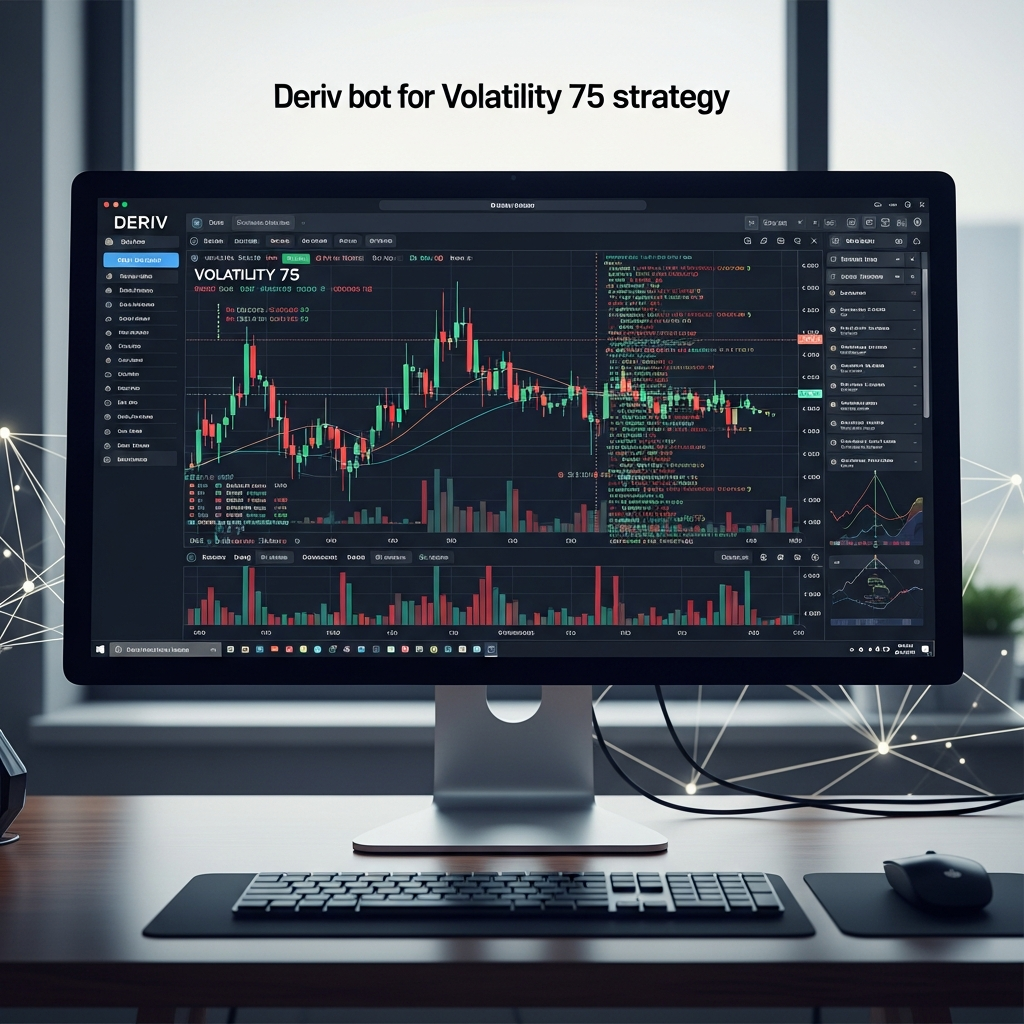
So, what actually goes into a successful Deriv bot for Volatility 75 strategy? You can’t just tell the bot to “buy low and sell high.” You need specific, quantifiable triggers. One of the most reliable setups I’ve found over the years involves the combination of Exponential Moving Averages (EMA) and the Relative Strength Index (RSI).
The Setup
- EMA 14 and EMA 50: We use these to determine the trend. If the 14 is above the 50, we’re looking for buys. If it’s below, we’re looking for sells.
- RSI (Period 14): This is our momentum filter. We don’t just buy because the trend is up; we buy when the market has pulled back and is starting to regain strength.
The logic for the bot would look something like this: If EMA 14 > EMA 50 AND RSI crosses above the 50 level, open a ‘Rise’ contract. This ensures you aren’t just jumping into a trend that’s already exhausted, but rather catching the momentum as it swings back in your favor.
Building Your First Bot on DBot
The Deriv ecosystem offers a tool called DBot, which is a visual programming interface. It looks a bit like Lego blocks. You drag and drop pieces of logic into four main blocks:
1. Trade Parameters
This is where you set your stake. For V75, I always recommend starting small. Even in 2026, the volatility is no joke. A stake of 0.35 USD (or the minimum equivalent in your currency) is the safest way to test your logic before going bigger.
2. Purchase Conditions
This is the brain of your Deriv bot for Volatility 75 strategy. This is where you’ll input the EMA and RSI logic we discussed. You’ll use the ‘Indicators’ tab to find these tools and link them with ‘Logic’ blocks (If/Do statements).
3. Sell Conditions
Most traders ignore this, but V75 moves so fast that sometimes you want the bot to sell a contract before it expires if the market turns against you. However, for many V75 strategies, we rely on the contract’s duration (usually 5 to 10 ticks or 1-2 minutes) to settle the trade.
4. Post-Trade Logic
What happens after a win? What happens after a loss? This is where you handle your money management. Do you want to stop after a $10 profit? Do you want to double the stake after a loss? (Be very careful with that last one!)
The Martingale Trap: A Word of Caution
We need to talk about the elephant in the room: Martingale. It’s the most common strategy used in a Deriv bot for Volatility 75 strategy. If you lose $1, you bet $2. If you lose $2, you bet $4. In theory, you eventually win and recover everything.
In practice, V75 can trend for a very long time without a single pullback. I’ve seen accounts wiped out in minutes because a bot hit 10 losses in a row and couldn’t cover the next stake. If you use Martingale, you must set a ‘Max Loss’ limit. Tell your bot: “If I lose 5 times in a row, stop everything and let me rethink.” It’s better to lose a small portion of your balance than to see the whole thing go to zero.
Risk Management in the Age of 2026
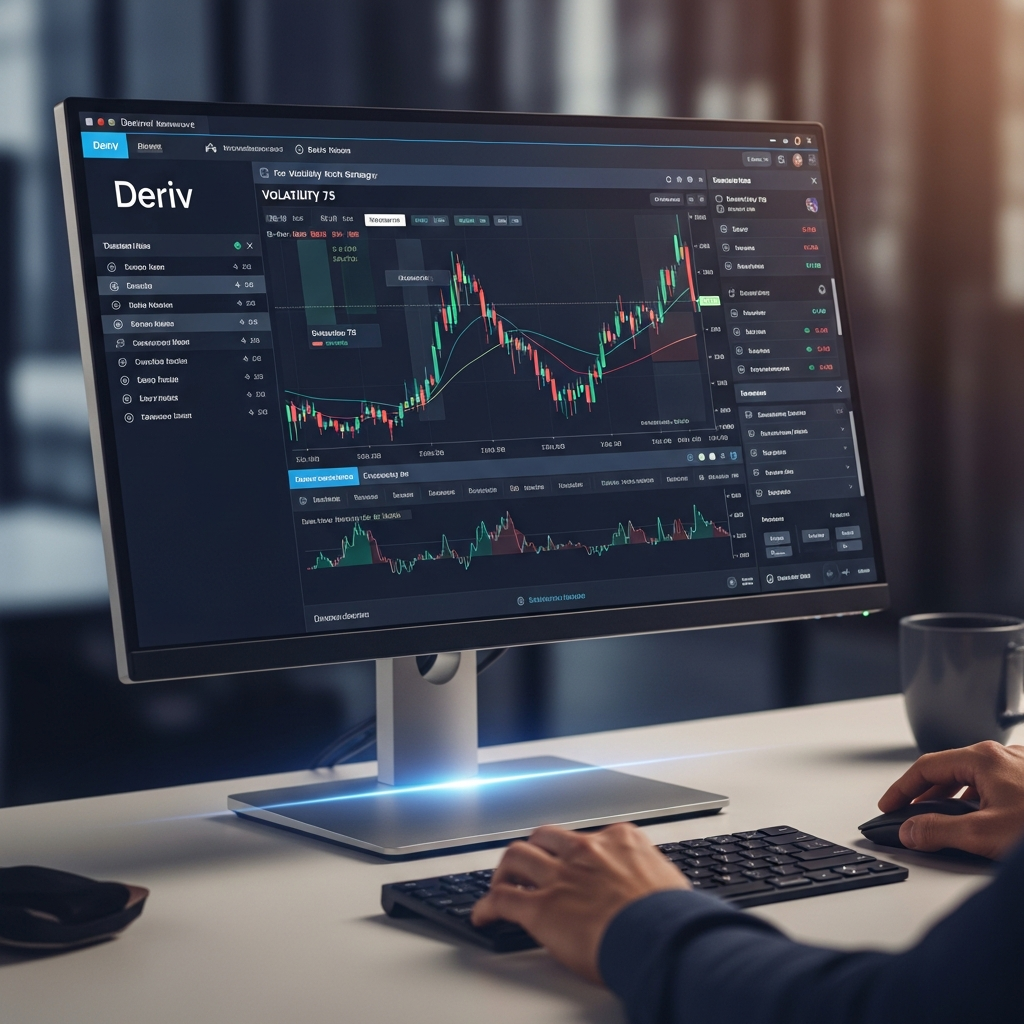
The smartest traders I know don’t focus on how much they can make; they focus on how much they can afford to lose. When configuring your Deriv bot for Volatility 75 strategy, follow these three golden rules:
- The 2% Rule: Never risk more than 2% of your total account balance on a single trade sequence.
- Take Profit (TP) is Mandatory: Greed is a bot-killer. If your goal is $20 a day, stop the bot the moment it hits $20.01. Don’t let it run “just one more time.”
- Session Limits: Don’t run your bot 24/7. Even though V75 is open all day, market conditions change. A strategy that works during a high-volume period might fail miserably when the market is ranging sideways.
Testing and Optimization: The Backtesting Phase
One of the beauties of the Deriv platform is the virtual account. Before you even think about putting real money into your Deriv bot for Volatility 75 strategy, you need to run it for at least 48 hours on a demo account.
Watch how it behaves. Does it struggle during specific times of the day? Does it lose too many trades in a row when the market is flat? Optimization isn’t about making the bot win every time—that’s impossible. It’s about making sure that when it loses, the losses are manageable, and when it wins, it capitalizes on the trend. In 2026, we have access to better historical data, so use it. Look at the past week of V75 movement and see how your bot would have performed.
Common Pitfalls to Avoid
Over the years, I’ve seen traders make the same mistakes over and over. Here’s how to stay ahead of the curve:
Over-complicating the logic: You don’t need 15 indicators. Too many filters will result in the bot never taking a trade, or worse, taking a trade too late. Stick to two or three reliable signals.
Ignoring the connection: A bot is only as good as its connection to the server. If your internet lag is high, your entry price might be different from what the bot intended. This is especially critical on V75 because of its speed. If possible, run your bot on a VPS (Virtual Private Server) to ensure 24/7 uptime and low latency.
Setting and forgetting: No bot is a “money printer” that you can leave alone forever. Markets evolve. An algorithm that works today might need adjustments in three months. Check your bot’s performance weekly and tweak the parameters if the market volatility shifts.
Psychology of Bot Trading
You might think that using a bot removes the psychological pressure of trading. It doesn’t; it just changes it. Instead of the stress of clicking ‘Buy’ or ‘Sell’, you experience the stress of watching your bot go through a losing streak.
I’ve been there—watching the screen, finger hovering over the ‘Stop’ button, wanting to intervene because I’m sure the next trade will be a loss. You have to trust your math. If you’ve backtested your Deriv bot for Volatility 75 strategy and you know it has a 60% win rate, you have to allow it to go through the 40% of losing trades without interfering. Intervention is often where the most damage is done.
The Future of V75 Automation
As we move further into 2026, the integration of simple machine learning into these bots is becoming more common. We’re starting to see bots that can adjust their own RSI levels based on the market’s average true range. While that sounds fancy, the core principle remains the same: price action and volatility management.
The Volatility 75 index remains the king of synthetic indices because of its liquidity and its technical respect for trends. Whether you are a seasoned pro or someone just starting out, building a Deriv bot for Volatility 75 strategy is one of the most proactive steps you can take toward a more disciplined trading career.
Final Thoughts for the Road
Trading V75 is a marathon, not a sprint. Using a bot gives you the sneakers you need to finish the race without collapsing from exhaustion. Start simple, prioritize risk management, and never stop learning. The tools available on Deriv today are more powerful than anything we had a decade ago. It’s a great time to be a trader, provided you have the right mindset and a solid piece of automation by your side.
Remember, the goal of a Deriv bot for Volatility 75 strategy isn’t to get rich by tomorrow morning; it’s to create a consistent, repeatable process that grows your capital over time while you spend your day living your life, not staring at candles. Happy trading!