
The Shift to Automated Trading: My Journey into 2026
Let’s be honest for a second. If you’re still sitting at your desk for fourteen hours a day, manual-clicking trades on every minor candle movement, you’re likely exhausted. I’ve been there. Back in the day, I thought manual trading was the only way to maintain control. But as we move through 2026, the landscape has shifted. The markets are faster, the volatility in synthetic indices is more intense, and human emotion remains our biggest enemy. That is exactly why finding the best deriv dbot strategies 2026 is no longer just a luxury—it is a survival requirement for anyone serious about consistent growth.
The DBot platform has evolved significantly. It’s no longer just a simple drag-and-drop tool for beginners. It’s a powerful environment where you can manifest complex logic without writing a single line of Python or C++. I remember my first bot; it was a disaster. I tried a simple Martingale on Volatility 100 and watched my balance vanish in three minutes. That failure taught me that a bot is only as smart as the person who builds it. Today, I want to share the setups that actually work in the current market environment.

The Multi-Step Martingale: Adding a Safety Net
Most traders hear the word “Martingale” and run for the hills. I don’t blame them. The traditional approach—doubling your stake every time you lose—is a one-way ticket to a zero balance. However, one of the best deriv dbot strategies 2026 involves a modified, or “smart,” Martingale. Instead of a mindless multiplier, we implement a circuit breaker.
Here’s how I set mine up. I don’t just double the stake. I use a multiplier of 1.1 or 1.2 and combine it with a “wait” period. If the bot loses three trades in a row, I programmed it to pause for five minutes. Why? Because markets often trend in a way that defies logic for short bursts. By forcing the bot to step back, you avoid the “death spiral.” In 2026, the most successful bots are those that know when to stop, not just when to trade.
Technical Setup for the Smart Martingale
- Market: Volatility 10 or 25 (Lower volatility is better for this).
- Trade Type: Over/Under (Specifically looking for Under 8).
- Multiplier: 1.15.
- Max Losses: 5 (After which the bot resets to the initial stake).
This approach isn’t about getting rich in ten minutes. It’s about grinding out small wins while keeping your drawdown manageable. It’s a marathon, not a sprint.
RSI and Bollinger Band Confluence: The Technical Powerhouse
If you prefer a strategy based on market physics rather than pure probability, this is for you. In 2026, technical analysis is still the backbone of the best deriv dbot strategies 2026. Many people make the mistake of using just one indicator. I’ve found that the real magic happens when you wait for two or more indicators to agree.
I call this the “Confluence Bot.” I set the DBot to look for instances where the price has touched the upper Bollinger Band AND the Relative Strength Index (RSI) is above 70. This suggests the market is overbought. Instead of just jumping in, I add a third layer: the bot must wait for one bearish candle to confirm the reversal. This layer of patience is what separates a winning bot from a losing one. It’s about finding that sweet spot where the odds are heavily skewed in your favor.
When you build this in DBot, you’re essentially creating a digital version of a disciplined floor trader. The bot doesn’t get “bored” or “revenge trade.” It just sits there, scanning the charts, waiting for the perfect moment. I’ve seen this strategy perform exceptionally well on the Volatility 75 (1s) index, where trends tend to be more respected.

The Trend-Follower: Riding the Volatility Waves
Synthetic indices are famous for their long, sustained trends. If you try to fight the trend, you will lose. The best deriv dbot strategies 2026 often focus on joining the momentum rather than predicting a reversal. Think of it like surfing; you don’t stand in the way of the wave, you hop on and ride it.
To implement a trend-following bot, I use Moving Averages. A simple crossover of the 10-period and 20-period Exponential Moving Averages (EMA) can be incredibly effective. When the 10 EMA crosses above the 20, the bot starts placing “Rise” trades. As long as the 10 stays above the 20, the bot stays active. The moment they cross back, the bot stops. This prevents you from getting caught in a range-bound market where bots usually get chopped up.
Key Blocks for Trend Trading
- Logic Block: If EMA 10 > EMA 20, Purchase Rise.
- Exit Condition: Stop trading if the price closes below the 20 EMA.
- Indices: Volatility 100 or Jump Indices for high momentum.
I’ve had days where a trend-following bot ran for four hours straight, catching a massive move on the Volatility 100 index. It’s a beautiful thing to watch when the logic holds up.
The Statistical Edge: Even/Odd Probability
Let’s talk about the math geeks. Some of the best deriv dbot strategies 2026 don’t look at charts at all. They look at the digits. The digit markets on Deriv are essentially a high-speed game of probability. While it might look like gambling to the untrained eye, there are patterns in the chaos.
One strategy I’ve refined involves tracking the last 50 digits. If the digit ‘5’ hasn’t appeared in the last 15 ticks, the probability of it appearing soon increases slightly. Or, more effectively, look for “Even/Odd” streaks. If the market produces four ‘Even’ digits in a row, the bot bets that the next one will be ‘Odd’. It’s a classic mean-reversion play applied to digits. It sounds simple, but when you combine it with a strict stop-loss, it can be surprisingly robust.
Risk Management: The Silent Partner
You could have the most sophisticated bot in the world, but if your risk management is trash, your account will follow. I cannot stress this enough. People ask me for the “best” bot, but they should be asking for the best risk settings. In 2026, the markets are efficient enough to punish any hint of greed.
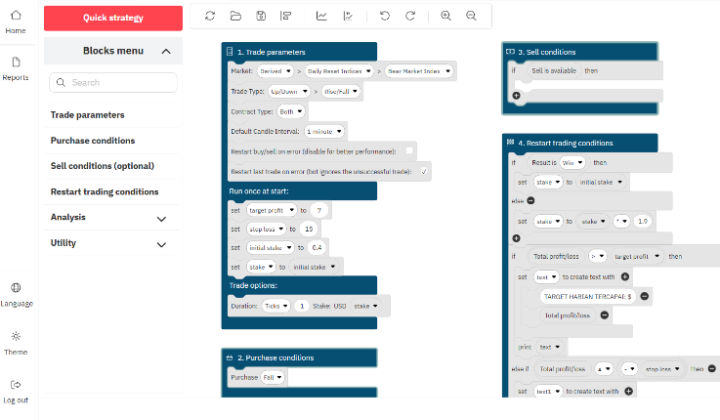
Every bot I run has a hard ‘Take Profit’ and a ‘Stop Loss’ limit. Once the bot hits a $20 profit, it shuts down. I don’t care if it looks like it could make $100. Greed is a bot-killer. Similarly, if it loses $15, it’s done for the day. Tomorrow is another opportunity. I also recommend using a “Virtual Hook.” This means the bot runs on a demo account and only switches to your real account after it has hit a streak of three losses. This way, you’re entering the market when a win is statistically “due.”
The Importance of Backtesting and Paper Trading
A mistake I see constantly is someone downloading a script they found on a forum and running it on a $1,000 real account immediately. That’s madness. Before I ever let a bot touch my real capital, I run it on the Deriv demo account for at least 48 hours. I want to see how it handles a spike in volatility. I want to see what happens when the connection flickers.
Backtesting in 2026 is more accessible than ever. Use the “Journal” tab in DBot to analyze your losses. Was the bot trading against a clear trend? Did it fail because the stake was too high? Use this data to tweak your blocks. Trading is a science, and your bot is your laboratory. If you aren’t testing, you’re just guessing, and the market has a very expensive way of telling you that you’re wrong.
Psychology of the Automated Trader
You might think that using a bot removes the emotional element of trading. It doesn’t. It just shifts it. Instead of feeling the stress of clicking “Buy,” you feel the stress of watching your bot go through a losing streak. The temptation to manually intervene is massive. I’ve been there—watching a bot lose three trades and wanting to hit the “Stop” button even though my strategy allows for five losses.
To succeed with the best deriv dbot strategies 2026, you have to trust your logic. If you’ve done the work, done the testing, and set the risk parameters, then you have to let the bot do its job. If you keep interfering, you’re no longer an automated trader; you’re just a manual trader with a very expensive and confusing interface. Set it, monitor it, but don’t micromanage it.
Adapting to Market Changes
What worked in January might not work in June. The beauty of DBot is its flexibility. The best deriv dbot strategies 2026 are those that are regularly audited. Every weekend, I sit down and look at my bot’s performance. If the market volatility has increased, I might widen my Bollinger Bands. If the trends are getting shorter, I might tighten my EMA crossover settings.
Stay connected with the community. There are thousands of traders on Deriv sharing their experiences. While you shouldn’t blindly follow anyone, listening to the challenges others are facing can give you a heads-up on changing market conditions. The market is a living, breathing entity, and your automation needs to be just as dynamic.
Final Thoughts on Mastering DBot
Automating your trading on Deriv is a journey of constant learning. It’s about blending the precision of a machine with the strategic oversight of a human. We’ve looked at Martingale tweaks, technical confluences, trend-following logic, and the raw math of digits. Each of these has its place in a balanced trading portfolio.
The real secret isn’t a hidden setting or a “magic” block. It is the discipline to stick to a plan and the wisdom to prioritize capital preservation over quick gains. As we navigate the opportunities of 2026, remember that the goal isn’t just to make money—it’s to create a sustainable, low-stress way to grow your wealth. Build your bots with care, test them with rigor, and always, always respect the risk. The future of trading is automated, and with the right approach, that future looks incredibly bright for those willing to do the work.