
The Great Trading Dilemma: Which Path Should You Take?
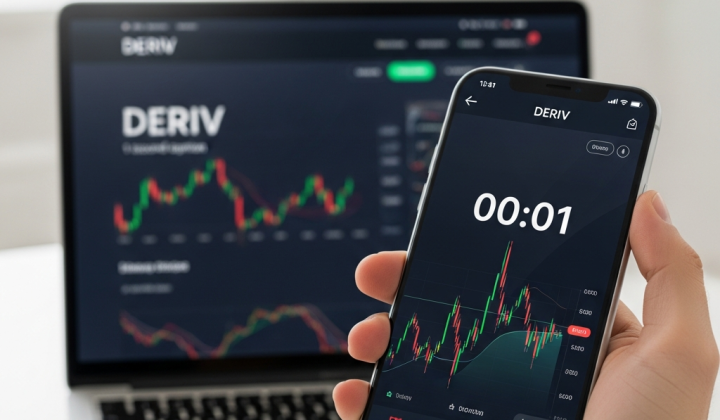
I remember sitting in front of my laptop at 2 AM back in the day, staring at the flashing red and green candles of the Volatility 75 Index. At that moment, I had two tabs open on my DTrader platform. One was set to Multipliers, and the other was set to Digital Options. I felt like a kid at a candy store who only had enough money for one treat. Do I go for the quick thrill of an option that expires in 60 seconds, or do I play the long game with a multiplier? If you have spent more than five minutes on the Deriv platform, you have likely faced this exact same crossroads. Choosing between Deriv multiplier vs options isn’t just about clicking a different button; it is about choosing a completely different philosophy of risk, time, and psychology.
By 2026, the trading landscape has shifted. We have more tools at our fingertips than ever before, but the core struggle remains: how do we maximize profit without losing our shirts? In this deep dive, we are going to strip away the jargon and look at these two heavyweights side-by-side. Whether you are a seasoned pro or someone who just signed up for a demo account this morning, understanding the nuance of how these instruments behave in the real world is your first step toward consistency.
The Multiplier: Trading with a Safety Net
Let’s start with the newcomer that changed the game. Before multipliers existed, you basically had two choices: CFDs or Options. CFDs allowed you to hold positions as long as you wanted but came with the terrifying risk of losing more than your initial investment if you didn’t set a stop loss properly. Options offered limited risk but had that annoying ticking clock. Then came the Deriv Multiplier.
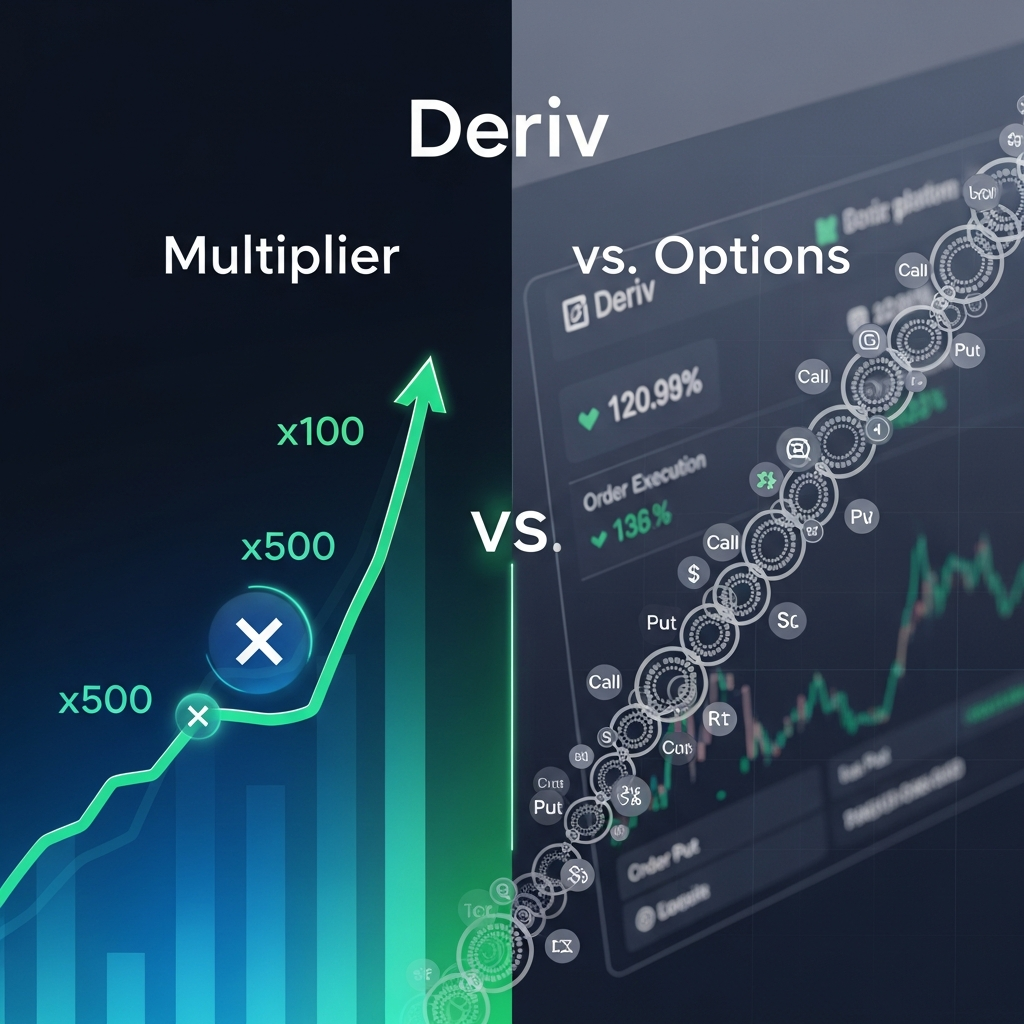
Think of a multiplier as a hybrid. It’s like a CFD but with a built-in protective bubble. When you enter a trade with a multiplier, you are essentially magnifying your market exposure. If you put down $10 with a x100 multiplier, you are controlling a $1,000 position. If the market moves in your favor by 1%, you make 100% profit. But here is the kicker—and the reason I personally lean toward them—your downside is strictly limited to your $10 stake. You can’t go into a negative balance. It is impossible.
One of the most human things about trading is the fear of “Stop Loss Hunting.” We’ve all been there—the market dips just enough to trigger your stop loss and then rockets in the direction you predicted. Multipliers on Deriv offer a feature called “Deal Cancellation.” For a small fee, you can actually undo a losing trade within a specific timeframe. It’s basically a time machine for your mistakes. When we compare Deriv multiplier vs options, this flexibility is a massive checkmark in the multiplier column.
The Option: The High-Stakes Sprint
Now, let’s talk about Options. These are the adrenaline junkies of the financial world. Trading options on Deriv—whether it’s Rise/Fall, Higher/Lower, or Touch/No Touch—is about one thing: being right about a specific outcome within a specific timeframe. You aren’t worried about *how far* the price moves; you just care that it’s above or below a certain point when the clock hits zero.
The allure here is the fixed payout. You know exactly what you stand to win before you even click “Purchase.” Usually, it’s somewhere between 70% and 95% of your stake. If you bet $10 and the trade goes your way, you get your $10 back plus $9.50 in profit in as little as one minute. It is clean, it is fast, and it is incredibly satisfying when you hit a winning streak.
However, the clock is a cruel mistress. In the Deriv multiplier vs options battle, options are often harder for people who struggle with timing. You could be 100% right about the market direction, but if the market takes 61 seconds to move and your option expired at 60 seconds, you lose everything. There is no middle ground. It’s binary—all or nothing.
Direct Comparison: Deriv Multiplier vs Options
To really get a feel for which one suits your personality, we need to look at them across four critical dimensions: Risk, Time, Profit Potential, and “The Stress Factor.”
1. Risk Management
With multipliers, your risk is dynamic but controlled. You can set an automatic take-profit or a stop-loss level. You can even move these levels while the trade is live. If you see the market turning against you, you can manually close the trade and salvage 50% of your stake. Options don’t offer that luxury. Once you buy an option, that money is committed. You are strapped into the rollercoaster until it reaches the end of the track. If the trade is losing halfway through, you generally can’t “exit” early for a partial refund (though some specific option types allow for a sell-back, the rates are usually poor).
2. The Role of Time
This is the biggest differentiator. Multipliers have no expiry. You can open a multiplier trade on Monday and, if the market doesn’t hit your stop-out level, you can still be in that trade on Friday. This allows you to breathe and let the market play out. Options are defined by time. Whether it’s 5 ticks or 24 hours, the moment that timer runs out, the story is over. If you are someone who gets anxious watching a countdown clock, multipliers are your friend. If you are someone who likes the “one and done” nature of a quick trade, options are built for you.
3. Profit Potential
In the Deriv multiplier vs options debate, profit potential is a bit of a toss-up. Options give you a high, fixed return very quickly. You can double your money in minutes. Multipliers, however, have technically uncapped upside. If the Volatility 100 Index goes on a massive bull run and you have a x500 multiplier, your profit could be 1,000%, 2,000%, or more. Multipliers reward big market moves, while options reward precision.

The Psychological Game: Which One Can You Stomach?
I’ve coached a few friends on Deriv over the last year, and I’ve noticed a pattern. The people who fail at options usually do so because they start “revenge trading.” They lose a 1-minute trade, get angry, and immediately double their stake to win it back. Because the cycle is so fast, they can blow an entire account in twenty minutes. It’s like a fast-food version of trading.
Multipliers require a different kind of patience. Because the trade can stay open indefinitely, the temptation there is to “hope.” You see the trade in the red, and instead of closing it, you tell yourself, “It’ll come back eventually.” Understanding your own psychological flaws is key to winning the Deriv multiplier vs options battle. If you are impulsive, the slow pace of multipliers might save you from yourself. If you are indecisive, the firm boundaries of options might actually help you make a clean break.
Practical Scenarios in 2026
Let’s look at how you might use these tools in a real-world 2026 market scenario. Imagine the Federal Reserve is about to make an interest rate announcement. The market is going to be incredibly choppy.
- The Multiplier Strategy: You could open a trade with a low multiplier (maybe x100) and a wide stop loss. This allows the market to whip up and down without knocking you out, eventually catching the long-term trend once the dust settles.
- The Options Strategy: You might use a “Stay Between” or “Ends Outside” option. Instead of betting on direction, you are betting on the *volatility* itself. You are betting that the price will move outside of a certain range within the next 10 minutes, regardless of whether it goes up or down.
This highlights a major point: these aren’t necessarily rivals. Many successful traders use both. They use multipliers for their core “directional” views and options for specific volatility-based plays.
Technical Setup: Navigating DTrader
The beauty of Deriv is that both of these are housed in the same interface. When you log into DTrader, the top-right menu allows you to switch between trade types instantly. For Multipliers, you’ll see the option to select your “Multiplier value.” Be careful here—in 2026, some assets allow up to x1000. Just because you *can* use x1000 doesn’t mean you *should*. A x1000 multiplier means a 0.1% move against you will close the trade. It’s essentially gambling on noise.
For Options, you’ll be looking at “Duration” and “Stake.” Always pay attention to the “Barrier.” The barrier is the line in the sand. If you are trading Higher/Lower, the barrier determines your payout. A harder-to-reach barrier means a much higher payout, sometimes exceeding 300%, but your probability of winning drops significantly.
The Verdict: My Honest Take
If you were to ask me which one is better, I wouldn’t give you a straight answer because “better” is subjective. However, I can give you a roadmap.
Choose Multipliers if you want to trade like a professional investor. It teaches you about price action, risk-to-reward ratios, and patience. It is the more “forgiving” instrument because it doesn’t punish you for being a few seconds late to the party. It’s my go-to for Forex pairs and the more stable Synthetic Indices.
Choose Options if you have a very specific strategy that relies on short-term momentum or if you are trading on a very small budget. Since you can start an option trade with as little as $0.35 on some indices, it’s a great way to learn market rhythm without risking a lot of capital. It’s also fantastic for “range” markets where the price isn’t really going anywhere, but you can still profit from it staying within a certain zone.
The battle of Deriv multiplier vs options usually ends with the trader realizing that the instrument is just a tool. A hammer isn’t better than a screwdriver; it just depends on whether you’re looking at a nail or a screw. My advice? Spend a week on the demo account. Trade nothing but multipliers for three days. Then trade nothing but options for three days. You will quickly realize which one makes your heart race in a bad way and which one gives you the “flow state” that all successful traders chase.
Trading in 2026 is faster and more accessible than ever. Whether you choose the magnified power of multipliers or the binary precision of options, stay disciplined, manage your risk, and never stop being a student of the charts. The market doesn’t care which button you click, but your bank account certainly does.