The Great Automated Trading Dilemma
It is 2 o’clock in the morning. You are staring at your screen, watching the little green and red dots flash across the interface of your Deriv DBot. Your heart races every time the trade goes against you, and you find yourself whispering to the monitor, “Just one win, that is all I need.” This scene is all too familiar for anyone who has dabbled in the world of automated binary trading. At the center of this emotional rollercoaster lies the ultimate choice: are you running a dbot martingale script vs non-martingale approach?
By 2026, the tools have become more sophisticated, the APIs are faster, and the market analysis blocks are smarter, but the fundamental psychology remains the same. We are all searching for that perfect balance between growing an account and not blowing it within thirty minutes of hitting the ‘Run’ button. If you have spent any time in trading forums or Telegram groups, you know the debate is fierce. Some swear by the rapid recovery of Martingale, while others view it as a mathematical suicide mission, preferring the slow-and-steady grind of non-martingale strategies.

The Allure of the Martingale Script: High Stakes and Quick Wins
Let’s talk about the elephant in the room. The Martingale strategy is probably the most famous (and infamous) betting system in history. Its logic is deceptively simple: every time you lose, you double your stake. When you eventually win, you recover all previous losses plus a small profit equal to your original stake. In the context of a DBot script, this means your XML blocks are programmed to multiply the next stake by 2.1 or 2.2 (depending on the payout) immediately after a ‘Loss’ contract is detected.
Why do people love it? Because it feels like you can’t lose. As long as you have enough balance, you only need one win to reset the cycle. It provides a smooth, upward-sloping equity curve—until it doesn’t. In the world of dbot martingale script vs non-martingale, the Martingale user is the sprinter. They want results now. They want to see that account balance tick up every few seconds.
The Mathematics of the ‘Death Run’
The danger of a Martingale script isn’t the first loss, or even the fourth. It is the tenth. In 2026, market volatility can produce long streaks of identical outcomes. If you are trading ‘Rise/Fall’ and the market enters a strong trend against you, seeing 10 or 12 losses in a row is not a statistical impossibility; it is a Tuesday. By the time you reach the 10th double-up, a $1.00 starting stake has turned into a $512.00 bet. If that loses, the 11th bet is over $1,000. For most retail traders, that is where the ‘Account Blown’ message appears.
The Rise of the Non-Martingale Approach
On the other side of the ring, we have the non-martingale strategies. These scripts operate on the philosophy that the stake should either remain constant (Flat Stake) or increase based on profit (Compounding/Parlay), rather than loss. In the dbot martingale script vs non-martingale debate, this is the marathon runner’s choice.
When you run a non-martingale script, you are essentially saying, “I trust my strategy’s win rate more than I trust a mathematical recovery trick.” If your bot has a 60% win rate, you don’t need to double up to make money; you just need to keep trading. Your losses are fixed. If you bet $10 and lose, you lose $10. Your next bet is still $10. This creates a much more stable psychological environment for the trader.
Why Non-Martingale is Gaining Ground in 2026
As we navigate the markets in 2026, traders are becoming more data-driven. We have access to better backtesting tools that show us the ‘Maximum Drawdown’ of a strategy. Non-martingale scripts allow for a much better Risk-to-Reward ratio. Instead of risking $1,000 to win $1 (which is what a high-step Martingale eventually does), a non-martingale script might risk $10 to win $9. It is a more sustainable way to trade for anyone looking to stay in the game for the long haul.
Direct Comparison: dbot martingale script vs non-martingale
To really understand which one fits your personality and pocketbook, we need to break them down across several key factors. Choosing between a dbot martingale script vs non-martingale isn’t just about the math; it’s about your lifestyle and goals.
- Risk Profile: Martingale is high-risk, high-reward (in the short term). Non-martingale is low-to-medium risk with steady growth.
- Capital Requirement: A Martingale script requires a massive ‘buffer’ or ‘bankroll’ to survive a losing streak. A non-martingale script can be run effectively with a much smaller account.
- Emotional Stress: Martingale causes high stress during losing streaks. Non-martingale allows for more ‘hands-off’ trading because a few losses won’t wipe you out.
- Time Efficiency: Martingale reaches profit targets very quickly. Non-martingale requires more time and more trades to reach the same daily goal.
Scenario: The Tale of Two Traders
Imagine Trader A and Trader B both start with $500.
Trader A uses a dbot martingale script starting at $1. Within two hours, they have made $20. However, they hit a 7-trade losing streak. Their stake jumped from $1 to $2, $4, $8, $16, $32, and finally $64. They won the 8th trade, but their heart was pounding the entire time.
Trader B uses a non-martingale script with a fixed $5 stake. They win 12 trades and lose 8. After two hours, they have made roughly $15 (assuming a 90% payout). They didn’t have a single moment of panic, and they didn’t have to risk a significant portion of their account on a single trade.
Hybrid Strategies: The Middle Ground
Is there a way to get the best of both worlds? In 2026, many advanced DBot users are moving toward ‘Smart Martingale’ or ‘Limited Recovery’ scripts. Instead of doubling forever, these scripts might only allow for 3 steps of Martingale before resetting to the initial stake and accepting the loss. This prevents the catastrophic ‘account blow’ while still providing some recovery power.
Another popular variation in the dbot martingale script vs non-martingale discussion is the ‘D’Alembert’ system. Here, you increase your stake by a fixed amount after a loss and decrease it by a fixed amount after a win. It is less aggressive than Martingale but more active than a flat stake. It provides a smoother experience for those who find flat staking too slow but find Martingale too terrifying.
The Technical Side: Building Your Script in DBot
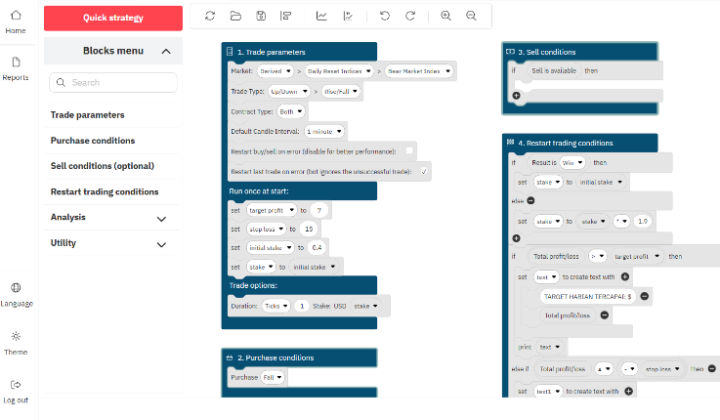
If you are looking to build or buy a script, you need to look at how the logic blocks are structured. In the DBot editor, the ‘After Purchase’ block is where the magic happens.
For a dbot martingale script, you use a variable (let’s call it ‘Stake’) and a conditional statement. If the ‘Contract Result’ is ‘Loss’, you set ‘Stake’ to ‘Stake * 2.1’. If it’s a ‘Win’, you reset ‘Stake’ to your ‘Initial Stake’.
For a non-martingale script, you simply keep the ‘Stake’ variable constant, or perhaps use a multiplier only on ‘Win’ results (this is called a Parlay or ‘Anti-Martingale’ strategy). This shifts the risk from your capital to your profits.
The Importance of the ‘Stop Loss’
Regardless of which side you take in the dbot martingale script vs non-martingale debate, your most important block is the ‘Stop Loss’. Without a hard limit, a Martingale script will eventually find a losing streak longer than your balance. Even a non-martingale script can suffer from a ‘death by a thousand cuts’ if the market conditions change and you don’t have a limit on how much you are willing to lose in a session.
Market Conditions: When to Use Which?
The truth is that neither script is ‘better’ in a vacuum. Their effectiveness depends entirely on the market.
Martingale scripts thrive in ‘ranging’ markets where the price bounces between two levels. In these conditions, you rarely see long streaks of one-way movement. You might lose two or three times, but the market usually reverses, giving you that ‘recovery win’.
Non-martingale scripts are far superior in ‘trending’ markets. If the market is moving strongly in one direction, you can follow that trend with fixed stakes and rack up a high win percentage without ever needing to double your risk. In 2026, with more AI-driven trend analysis, many traders are finding that identifying the trend first and then running a non-martingale bot is the most professional way to approach the platform.
The Psychology of Automated Trading
We often think that by using a bot, we are removing emotion from trading. This is a myth. When you choose a dbot martingale script vs non-martingale, you are choosing which type of emotion you want to manage.
With Martingale, you are managing fear—the fear of that one big loss. With non-martingale, you are managing impatience—the frustration that your account isn’t growing as fast as you want it to. Understanding your own personality is key. If you are someone who can’t stand seeing red on the screen, Martingale might actually be worse for you because when the red comes, it comes in massive, terrifying chunks.
Final Thoughts for the 2026 Trader
The landscape of automated trading continues to evolve. We have better indicators, faster execution, and more community-shared scripts than ever before. However, the core choice between the dbot martingale script vs non-martingale remains the most significant decision you will make in your trading journey.
My advice? Don’t jump into Martingale just because you want a ‘quick win’. Most people who start that way end up back at the deposit screen within a week. Start with a non-martingale or a very limited recovery script. Learn how the market breathes. Observe how your bot reacts to news events and volatility spikes.
Trading is a business, not a casino. While the doubling-up logic of a Martingale script feels like a shortcut to wealth, the most successful traders in 2026 are those who prioritize capital preservation over rapid gains. Whether you choose the aggressive path or the conservative one, make sure you understand the math behind your script. Test it on a demo account for weeks, not hours. See how it handles a 10-trade losing streak. If you can’t stomach the potential loss, then the script isn’t right for you.
At the end of the day, the ‘best’ script is the one that allows you to sleep at night while it runs in the background. If you are constantly checking your phone every five minutes to see if your Martingale bot has blown your account, you haven’t automated your trading—you’ve just automated your anxiety. Choose the strategy that fits your risk tolerance, set your limits, and let the math work in your favor, not against it.