Deciding Your Trading Path in 2026
Walk into any digital trading floor today, and the chatter is no longer just about whether the Euro is going up or down. It’s about how you choose to bet on that movement. If you have spent more than five minutes looking at brokerage platforms recently, you have likely run into a fork in the road: do you go with the traditional, high-adrenaline world of currency pairs, or do you dive into the structured, defined-risk world of options? This is a crossroad every trader faces, and quite frankly, it can feel a bit overwhelming if you do not have a clear roadmap.
I remember sitting at my desk back in the day, staring at a MetaTrader 4 screen with twenty different indicators, feeling like I needed a PhD in macroeconomics just to place a 0.10 lot size trade. Then, I discovered options and the world seemed to flip on its head. But neither is a magic pill. Today, we are going to break down a comprehensive Deriv options trading vs forex comparison to see which one actually aligns with your personality, your wallet, and your long-term goals in this 2026 financial landscape.
Understanding the Core Differences
Before we get into the weeds, let’s define the players. Forex is the global marketplace where you swap one currency for another. You profit from the difference in price movement. If the USD gets stronger against the JPY, and you are ‘Long,’ you make money. It is straightforward but involves a lot of moving parts like leverage, margins, and stop-losses.
On the other hand, Deriv options allow you to trade on the movement of an underlying asset without actually owning it. On the Deriv platform, this usually takes the form of Digital Options (where you predict if a price will be higher or lower than a specific point at a specific time) or Lookbacks and Barriers. Essentially, you are buying a contract on a prediction.
What Exactly Are Deriv Options?
Deriv has spent years carving out a niche that moves away from the ‘standard’ binary options of the past. Their options ecosystem includes:
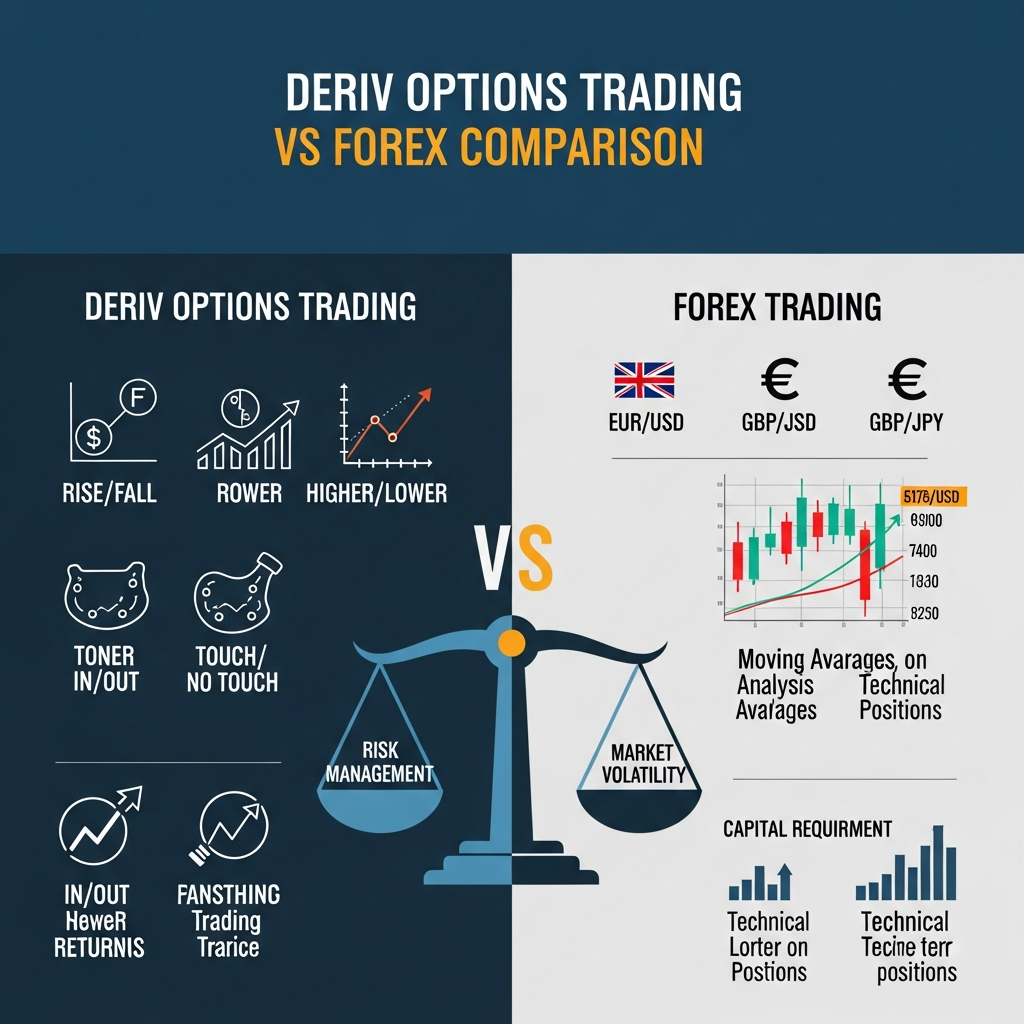
- Rise/Fall: The classic. Will it be higher or lower than the entry price?
- Higher/Lower: Predicting if the exit price will stay above or below a target price.
- Touch/No Touch: Does the market ever hit a specific price level during the contract duration?
- Multipliers: A unique hybrid that combines the limited risk of options with the profit potential of Forex.
The Traditional World of Forex Trading
Forex trading on Deriv typically happens through the MT5 (MetaTrader 5) terminal. Here, you are dealing with pips. You decide when to enter, and more importantly, you decide when to leave. Unlike an option, a Forex trade doesn’t have a ‘timer’ that automatically closes the position unless you hit a stop-loss or a take-profit level. You have total control, but that control comes with the heavy burden of constant monitoring.
Risk Management: Fixed vs. Variable
This is where the Deriv options trading vs forex comparison gets real. Ask yourself: how well do you sleep when you have an open trade? If the thought of a ‘flash crash’ wiping out your account keeps you up, options might be your best friend. With Digital Options, your risk is capped at the amount you paid for the contract. If you put down $50, the most you can lose is $50. No more, no less. There is a certain psychological peace that comes with knowing the absolute worst-case scenario before you even click ‘Buy.’
Forex is a different beast. While you can use stop-losses, slippage can occasionally happen during high-volatility events (though it is rarer in 2026 thanks to improved liquidity). In Forex, your losses are variable. If the market gaps against you, you could theoretically lose more than your initial margin if you aren’t using a broker with negative balance protection. However, the flip side is that your profit is also uncapped. In a massive trending market, a Forex trade can run for hundreds of pips, making you a fortune from a single entry. Options, meanwhile, usually have a fixed payout—often between 70% to 95% of your stake.
Market Availability and Accessibility
One of the biggest pain points for traditional Forex traders is the weekend. On Friday evening, the market shuts down, and you are left at the mercy of weekend news that could cause a massive gap on Monday morning. I have seen many traders lose their shirts because of a geopolitical event that happened while the markets were closed.
Deriv solves this through their Synthetic Indices. These are markets that are cryptographically generated and mimic real-world market volatility but are available 24/7, 365 days a year. When we talk about a Deriv options trading vs forex comparison, accessibility is a huge win for the options side if you are a weekend warrior. You can trade ‘Volatility 100’ or ‘Boom and Crash’ indices on a Sunday afternoon while the traditional Forex markets are dead silent.
The 24/7 Advantage of Synthetic Indices
Why does this matter? Because for many of us, the 9-to-5 job is still a reality. If you only have time to trade late at night or on weekends, traditional Forex limits you to specific sessions (like the Asian session, which can be slow). With Deriv’s options on synthetic indices, the volatility is consistent regardless of the time of day. It provides a level of freedom that traditional currency pairs simply cannot match.

The Learning Curve and User Experience
Let’s be honest: MetaTrader 5 looks like software from the early 2000s. It’s powerful, yes, but it’s intimidating for a beginner. You have to understand leverage, margin calls, lot sizes, and swap rates. If you mess up the math on your lot size, you could risk 10 times more than you intended.
Deriv’s proprietary platforms—like DTrader and SmartTrader—are built for the modern human. The interface is clean, the math is done for you, and the ‘Buy’ button is clear. For someone just starting, the Deriv options trading vs forex comparison leans heavily toward options in terms of user experience. You pick your duration (from 1 tick to 365 days), pick your stake, and go. There is less ‘clutter’ between your brain and the trade execution.
Profit Potential: Calculating the Upside
If you are looking for that ‘one big trade’ that changes your life, Forex is technically the better vehicle for it. Through the power of compounding and trailing stop-losses, a small account can grow exponentially during a major currency trend. You aren’t limited by a ‘payout percentage.’ If the market moves 500 pips and you have the patience to hold, you reap the full reward.
Options are more about ‘consistency’ and ‘probability.’ Because you know the payout (e.g., 90%) and the timeframe (e.g., 5 minutes), you can build a mathematical model around your win rate. It’s less about catching a ‘big wave’ and more about accurately predicting short-term price action. In 2026, many professional traders use options as a way to generate daily cash flow while keeping their Forex positions for long-term wealth building.
Strategy Implementation: Which Fits Your Style?
Your strategy will likely dictate your choice. Are you a scalper? Do you like quick, 1-minute bursts of activity? If so, Deriv options—specifically ‘Ticks’ trading—will feel like home. You can enter and exit a trade in under 10 seconds. Trying to scalp Forex for 1-2 pips is often a losing battle due to the spread (the difference between the buy and sell price).
Are you a swing trader? Do you like analyzing daily charts and holding positions for a week? Then Forex is your playground. Options become very expensive if you want to hold them for weeks at a time because of the ‘time decay’ or the premium you have to pay for a long-duration contract. In Forex, you just pay a small ‘swap’ fee (or nothing at all on swap-free accounts) to keep your position open overnight.
- Options Strategy: Focusing on support/resistance ‘bounces’ with short expiry times.
- Forex Strategy: Focusing on trend following, breakout patterns, and fundamental economic shifts.
- The Hybrid Approach: Using Deriv Multipliers to get the best of both worlds—limited risk with the ability to let profits run.
The Psychology of the Trade
We cannot ignore the ‘human’ element in this Deriv options trading vs forex comparison. Trading is 80% psychology. The biggest problem Forex traders face is ‘greed’ and ‘hope.’ They stay in a losing trade ‘hoping’ it will turn around, or they close a winning trade too early because they are ‘afraid’ of losing what they have.
Options remove a lot of this emotional torture. Once you place the trade, your job is done. You cannot move your stop-loss further away in a fit of desperation. You cannot close the trade 2 seconds early because you got nervous (in most contract types). The ‘set it and forget it’ nature of options can actually make you a more disciplined trader because it forces you to accept the outcome from the moment you click the button.
Fees, Spreads, and Hidden Costs
In the Forex world, you are always fighting the spread. The moment you open a trade, you are in the red. You need the market to move in your favor just to break even. While Deriv has some of the tightest spreads in the industry, it is still a factor to consider, especially during low-liquidity hours.
With options, there is no ‘spread’ in the traditional sense. The ‘cost’ of the trade is built into the payout. If you risk $1 to make $0.90, that $0.10 difference is the broker’s edge. It is transparent. You don’t have to worry about ‘commission per lot’ or ‘slippage on exit.’ What you see is exactly what you get. For many traders in 2026, this transparency is the deciding factor in the Deriv options trading vs forex comparison.
Making the Choice: A Practical Guide
So, where does that leave you? If you are still on the fence, I suggest looking at your lifestyle. If you are a high-energy person who wants fast results and can handle the ‘all or nothing’ nature of a contract, start exploring the DTrader platform. The ability to trade synthetic indices means you can practice your craft any time you want without waiting for London or New York to wake up.
However, if you enjoy the ‘art’ of the chart—spending hours identifying long-term trends and understanding the relationship between the US Federal Reserve and the European Central Bank—then MT5 and Forex are where you belong. There is a certain prestige and depth to Forex that options just don’t have.
The beauty of using a platform like Deriv is that you don’t actually have to choose just one. You can have a Forex account for your serious, long-term capital and an options account for your short-term, tactical trades. Most successful traders I know in 2026 do exactly that. They use the stability of one to fund the aggression of the other.
Don’t let analysis paralysis stop you. The best way to settle the Deriv options trading vs forex comparison for yourself is to open a demo account for both. Spend a week trading the EUR/USD on MT5, then spend a week trading ‘Rise/Fall’ on the Volatility 75 Index. Your gut will tell you which one feels right. Trust your instincts, manage your risk, and remember that the goal isn’t to be ‘right’—it’s to be profitable.