That Heart-Stopping Moment When the Price Moves Without You
We’ve all been there. You’ve spent hours analyzing the charts, waiting for that perfect breakout on Volatility 75 or the EUR/USD. You click ‘buy’ with total confidence, but instead of an instant fill, the little loading wheel spins for a fraction of a second. By the time the trade opens, the price has already skipped five pips ahead. You’ve just fallen victim to latency, the silent profit-killer. This is exactly why knowing the Deriv server locations 2026 setup is more than just a technical curiosity—it’s a survival skill for your trading account.
Trading in 2026 isn’t just about who has the best strategy; it’s about who has the fastest path to the engine. As Deriv has expanded its global footprint, the way they distribute their server load has changed significantly. If you’re still using the same server settings you had three years ago, you might be leaving money on the table through slippage and slow execution. Let’s break down where these servers actually live and how you can pick the one that gives you an unfair advantage.

The Current Map: Mapping Out Deriv Server Locations 2026
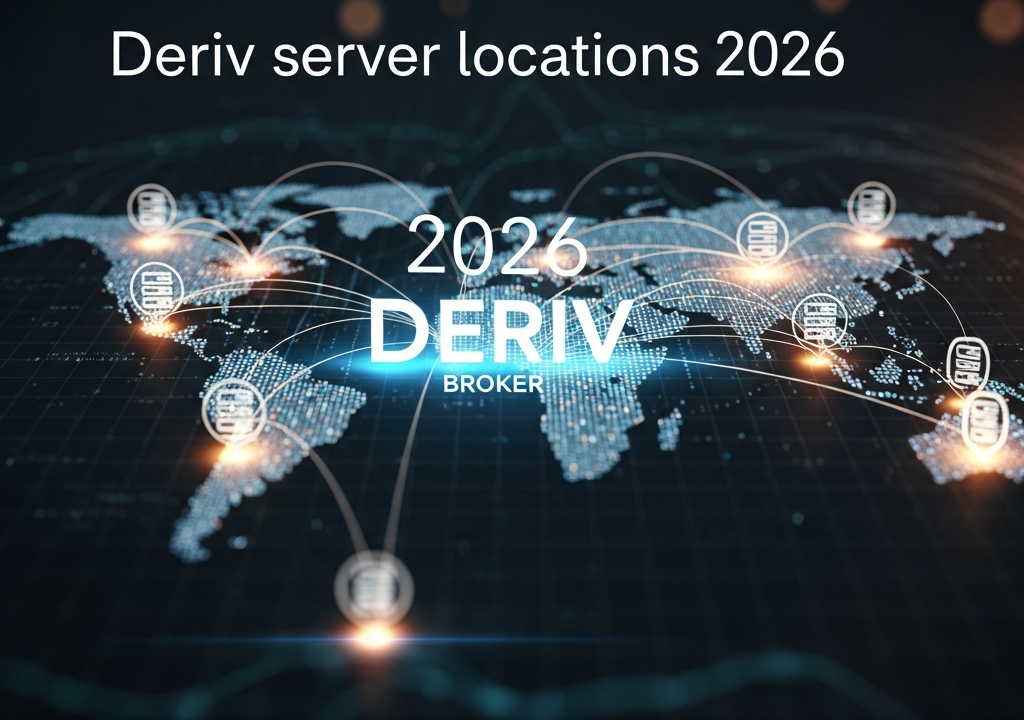
Deriv doesn’t just keep all their eggs in one basket. To serve millions of traders across different continents, they utilize a decentralized network of high-performance data centers. By 2026, the infrastructure has matured into a sophisticated web that covers almost every major economic hub. Here is where the primary action happens:
- Europe (The Frankfurt and London Hubs): These remain the crown jewels for Forex traders. If you are trading major currency pairs, these servers offer the lowest latency because they are physically close to the liquidity providers (the big banks).
- Asia-Pacific (Singapore and Hong Kong): For traders in Southeast Asia, Australia, and India, the Singapore data center is the gold standard. It’s designed to handle the massive surge in traffic from the booming Asian market.
- Africa (Johannesburg and Lagos nodes): Deriv has made massive strides in Africa. In 2026, the Johannesburg server serves as a critical bridge, drastically reducing the ping for South African and neighboring traders who used to have to connect all the way to London.
- The Americas (Virginia, USA and São Paulo): While Deriv’s availability varies by region in the Americas, their infrastructure in Virginia (US East) is a primary hub for many of their backend services and synthetic index calculations.
Why Does Physical Distance Still Matter?
You might think that in 2026, with satellite internet and 6G rolling out, distance shouldn’t matter. But physics hasn’t changed. Light travels through fiber optic cables at a finite speed. If you are in Nairobi and your trade request has to travel to a server in London and back, that’s a round trip of thousands of miles. Every extra millisecond increases the chance that the price will change before your order is processed. By choosing the correct Deriv server locations 2026, you are essentially shortening that physical wire.
The MT5 vs. Deriv X Server Split
It is a common mistake to assume that all Deriv platforms run on the same server. They don’t. The infrastructure for MetaTrader 5 (MT5) is architected differently than the web-based Deriv X or the DTrader platform. MT5 is built for raw speed and is often hosted on dedicated hardware designed to handle High-Frequency Trading (HFT) and Expert Advisors (EAs).
When you open an MT5 account, you’ll often see server names like “Deriv-Server” or “Deriv-Server-02”. These aren’t just random numbers. Usually, “Deriv-Server” refers to the primary European hub, while higher numbers often correspond to newer clusters in Asia or specialized servers for Synthetic Indices. If you’re noticing lag, switching your account type to one hosted on a different server cluster can sometimes solve the problem instantly.

How to Find Your Best Server: A Step-by-Step Guide
Don’t just guess which server to use. You can actually test this. Most traders ignore the little connection bars at the bottom right of their MT5 terminal, but that’s where the secrets are hidden. Here is how you should approach it:
- Check the Ping: Click on the connection status icon in MT5. It will show you a list of access points and their latency in milliseconds (ms). Anything under 50ms is excellent. Over 150ms is getting into the danger zone for scalping.
- Match Your Strategy: If you are a swing trader holding positions for days, 200ms won’t kill you. But if you are using a 1-minute ‘Crash/Boom’ strategy, you need the absolute lowest latency possible.
- Use a VPS if Necessary: If you live far from the major Deriv server locations 2026, consider renting a Virtual Private Server (VPS) located in London or Singapore. You then run your MT5 on that VPS, ensuring your trades reach the Deriv engine in under 5ms.
The Special Case of Synthetic Indices
Deriv’s Synthetic Indices are unique because they aren’t influenced by real-world events or bank hours. They are generated by an algorithm. The servers that run these algorithms are highly optimized. In 2026, these are mostly centralized in high-security data centers with massive redundancy. Even if one node in the Deriv server locations 2026 network goes down, the synthetic market usually keeps ticking without a glitch because of the way they’ve distributed the ‘heartbeat’ of the algorithm across multiple regions.
Common Myths About Deriv Servers
I hear a lot of chatter in trading forums, and much of it is just plain wrong. Let’s clear the air on a few things. First, some people think that using a VPN will make their connection faster. In 99% of cases, a VPN makes it slower because it adds another “stop” on the journey your data takes. Unless your ISP is specifically throttling your connection to trading servers, skip the VPN for execution speed.
Another myth is that all servers are the same during high-impact news. Actually, some server clusters are more robust than others. During NFP (Non-Farm Payrolls) or major interest rate decisions, the primary servers in Europe can get congested. Sometimes, being on a secondary, less-populated server can actually lead to smoother execution during high volatility.
The Role of Cloud Infrastructure in 2026
By 2026, Deriv has moved much of its heavy lifting to hybrid cloud solutions. This means that while there are physical “anchor” servers in places like Frankfurt, the system can “burst” into the cloud during times of high traffic. This elasticity is why we see fewer total system crashes than we did five years ago. When you look at the Deriv server locations 2026 map, you’re looking at a mix of physical metal and virtualized cloud power that can scale up or down in seconds.
Maintenance and Downtime: What to Expect
No server is perfect. Maintenance usually happens during the weekends when the Forex markets are closed. However, since Synthetic Indices run 24/7, Deriv uses a rolling maintenance schedule. They move traffic from one server location to another, perform the updates, and then move it back. If you ever see a “Market Closed” message on a synthetic pair on a Tuesday, it’s usually a localized server sync happening, and switching to a different access point often brings the charts back to life.
The Impact on Expert Advisors (EAs)
If you’re a bot trader, the Deriv server locations 2026 update is critical. EAs react to price changes in microseconds. If your EA is running on a home computer in a region far from the server, your bot is essentially “blind” for a few milliseconds of every second. It’s seeing old prices. For those of us using automated tools, the location of the server is the single most important factor after the strategy itself. Always colocate your bot as close to the server as possible.
Looking Ahead: Why This Matters for Your Bottom Line
At the end of the day, trading is a game of margins. You are competing against millions of other traders and institutional algorithms. If you can save 20ms on every trade, over the course of a year, that adds up to significantly less slippage and more accurate entries. By staying informed about the Deriv server locations 2026, you’re making sure your technical setup is as sharp as your market analysis.
Don’t just take my word for it. Open your platform today, check those latency numbers, and see if you’re actually connected to the best possible hub for your area. If you’re seeing high numbers, it might be time to contact support or look into a VPS solution. Your bank account will thank you for those extra milliseconds of speed.
Speed is the new currency in 2026. Make sure you’re not trading with yesterday’s connection. Whether you are scalping the volatility indices from a beach in Bali or trading majors from a home office in Berlin, being aware of where your data is going is the first step toward professional-grade execution.