The Evolution of Automated Trading: Why We Are Having This Talk
Let’s be honest for a second. If you’ve spent more than a week exploring the world of synthetic indices or binary options, you’ve probably felt that itch—the urge to stop staring at candles and let a machine do the heavy lifting. I remember the first time I loaded a .xml file into a browser window; it felt like I’d unlocked a secret level in a video game. But as the landscape shifted from the classic Binary.com to the modern Deriv ecosystem, a lot of traders got left in the dust, wondering where their favorite tools went.
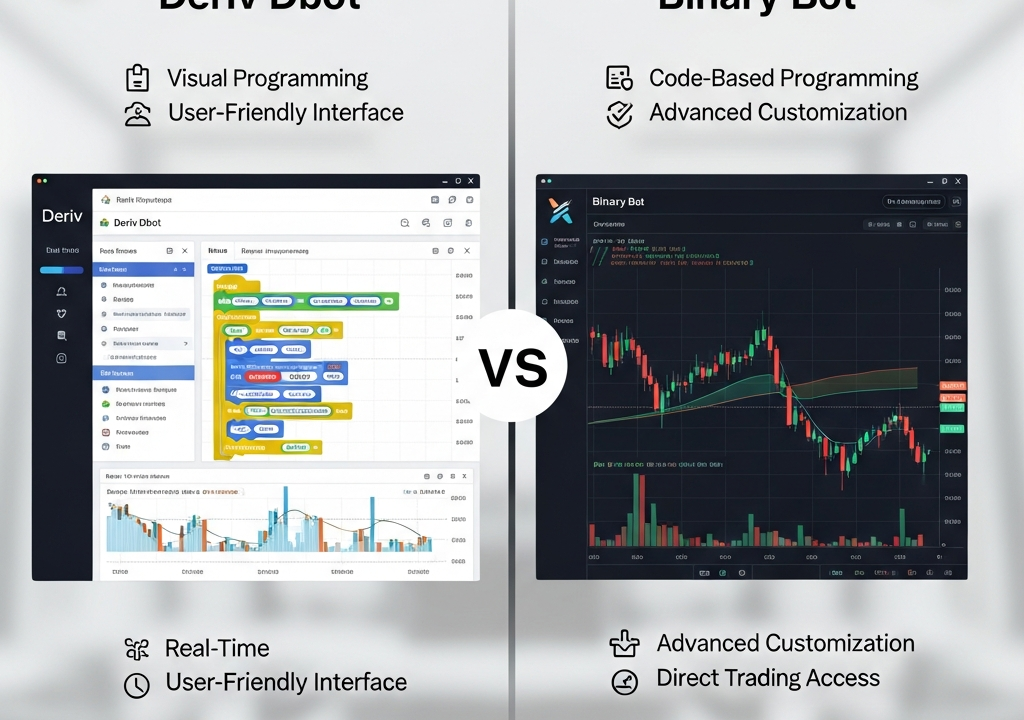
It’s 2026, and while the core technology has stayed remarkably stable, the way we interact with these bots has changed. People often ask me, “Is the old way still better?” or “Is the new platform just a shiny coat of paint?” That’s exactly why this deriv dbot vs binary bot comparison exists. I want to cut through the marketing fluff and tell you how these two platforms actually feel when you’re risking your hard-earned capital in a volatile market.

The Nostalgic Powerhouse: What Was (and Is) Binary Bot?
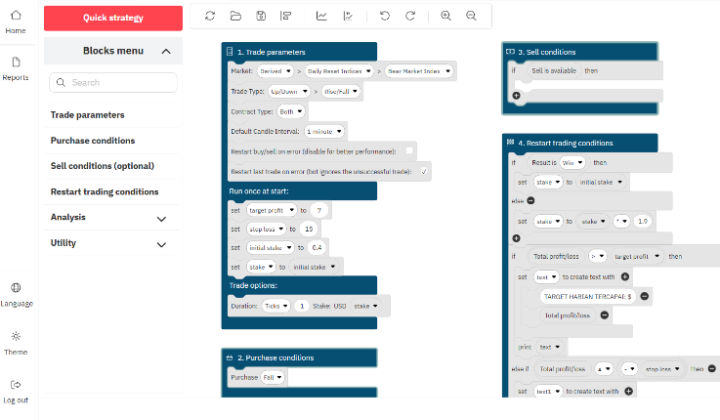
Binary Bot is the grandfather of accessible retail algorithmic trading. Long before every fintech app had an AI assistant, Binary Bot was giving regular people the power to build complex logic using Google’s Blockly framework. It was revolutionary because it didn’t require you to know a lick of Python or C++. You just dragged a “Purchase” block into a “Trade Parameters” block, and boom—you were a coder.
Even today, a huge chunk of the community clings to Binary Bot. Why? Because it’s familiar. It’s like that old pair of leather boots that has finally molded to your feet. It’s lightweight, it runs in almost any browser without lag, and it’s compatible with the thousands of free strategies floating around on GitHub and Telegram. When we look at a deriv dbot vs binary bot comparison, we have to acknowledge that Binary Bot set a high bar for simplicity.
However, it does show its age. The interface feels like a relic from 2015. There’s no built-in cloud storage for your bots, and if your browser crashes without you having saved your work locally, those three hours of fine-tuning your Martingale logic are gone into the digital ether.
The Modern Contender: What Does DBot Bring to the Table?
Then came DBot. When Deriv rebranded and overhauled their tech stack, they didn’t just want to copy the old bot; they wanted to integrate it into a unified trading experience. DBot is the sleek, dark-mode-friendly successor that lives right inside the Deriv ecosystem.
The first thing you’ll notice in this deriv dbot vs binary bot comparison is the visual fidelity. DBot looks like a tool built for 2026. It’s integrated with your Deriv account seamlessly, meaning you can switch between your DTrader platform and your bot workspace with a single click. It also introduced “Quick Strategies,” which are essentially pre-built templates for popular methods like Martingale, D’Alembert, and Oscar’s Grind. For a beginner, this is a godsend. You don’t have to build the logic from scratch; you just input your stake and your profit goal, and the bot builds itself.
The Core Deriv DBot vs Binary Bot Comparison: Head-to-Head
Let’s get into the nitty-gritty. If you’re deciding where to host your next Volatility 75 Index strategy, you need to know the specific differences in how these platforms perform.
1. User Interface and Workspace Management
Binary Bot uses a very wide-open canvas. It feels like a literal drawing board. DBot, on the other hand, uses a more structured side-panel approach for navigation. In DBot, you have a dashboard where you can see your recent bot performance, a library for your saved bots, and a dedicated import/export section.
- Binary Bot: Minimalist, retro, requires manual saving to your hard drive.
- DBot: Modern, integrated, offers cloud saving (if you’re logged into your Deriv account).
If you’re the type of person who loses files easily, DBot is the winner here. Having your strategies saved to the cloud means you can move from your desktop to a laptop at a coffee shop without carrying a USB drive full of .xml files.
2. Logic Building and Block Complexity
In this deriv dbot vs binary bot comparison, the actual logic blocks are surprisingly similar. Both use the same underlying logic (Google Blockly), which is great news. It means the “Math,” “Logic,” and “Text” blocks work almost identically. However, DBot has simplified some of the “Trade Parameters.” In the old Binary Bot, you had to be very specific about setting up your contract type and duration in a way that felt a bit clunky. DBot streamlines this with a more intuitive “Contract Definition” block.
That said, some power users argue that Binary Bot feels “snappier.” When you have a bot with 500+ blocks (which, let’s be honest, is probably overkill), Binary Bot’s workspace often handles the rendering better than the more asset-heavy DBot interface.

3. Execution Speed and Reliability
This is where things get subjective. In my experience, and based on community feedback in 2026, the execution speed is nearly identical because they both talk to the same API. The difference lies in the “Visual Lag.” Because DBot is running more background processes for its fancy UI and real-time statistics tracking, it can sometimes feel slower on older computers.
If you are running a high-frequency “Ticks” strategy where every millisecond counts, you might find the stripped-back nature of Binary Bot more comforting. But for most traders running 1-minute to 5-minute candles, the difference is negligible.
4. Mobile Compatibility
Neither of these is truly a “mobile-first” experience. Trying to drag blocks around on a 6-inch screen is a recipe for a headache. However, if you just want to run a bot you’ve already built, DBot is much easier to manage on a mobile browser. Its responsive design actually fits the screen, whereas Binary Bot requires a lot of zooming and panning just to find the “Run” button.
The Migration Struggle: Can You Move Your Bots?
A huge point in any deriv dbot vs binary bot comparison is backward compatibility. If you have a library of .xml files from 2022, will they work in DBot?
The answer is: mostly. Deriv has built an importer that allows you to bring your Binary Bot files into DBot. Most of the time, the blocks map perfectly. However, if your bot used very specific custom JavaScript or weird workarounds that were unique to the old platform, you might see some “unknown block” errors.
I always tell traders to treat a migration as a chance to clean up their code. Use the importer, but then manually check your “Purchase” and “Restart Trading” logic. It’s better to spend 20 minutes auditing the blocks than to realize your Martingale multiplier didn’t carry over after you’ve already lost three trades in a row.
Which One Should You Choose in 2026?
There is no one-size-fits-all answer, but I can give you some scenarios.
Choose Binary Bot if:
- You are a purist who likes a distraction-free, lightweight environment.
- You are running very large, complex XML files that slow down modern browsers.
- You prefer keeping all your strategy files offline and local.
- You’re following an old-school tutorial that uses the classic interface.
Choose DBot if:
- You want a modern, dark-mode interface that’s easy on the eyes during late-night sessions.
- You value cloud storage and being able to access your bots from any device.
- You are a beginner who wants to use “Quick Strategies” to get started without learning block logic immediately.
- You want a more integrated experience with the rest of the Deriv ecosystem.
The Secret Sauce: It’s Not the Bot, It’s the Logic
I want to take a step back from the deriv dbot vs binary bot comparison for a moment. Whether you use the old platform or the new one, the bot is just a tool. It’s an employee that follows your instructions perfectly—even if those instructions are bad.
In 2026, the markets are faster and more algorithmic than ever. A bot that worked in 2020 might get chewed up today. The real skill isn’t choosing between DBot and Binary Bot; it’s learning how to manage your risk. I’ve seen traders build the most beautiful, complex structures in DBot, only to blow their account because they didn’t set a stop-loss. Conversely, I’ve seen people use a simple 5-block strategy on the old Binary Bot and make consistent gains because they understood market cycles.
Practical Tips for Both Platforms
Regardless of which side of the fence you fall on, here are a few rules I live by when automating my trades:
- Always Test on Virtual First: This sounds obvious, but you’d be surprised how many people live-test a new bot. Run it on your demo account for at least 100-200 trades to see how it handles a losing streak.
- Watch Your Logs: Both platforms have a log window. Don’t just look at the green and red boxes. Look at the error messages. If your bot is failing to execute a trade due to “Contract price changed,” you might need to adjust your slip allowance or check your internet connection.
- Keep it Simple: The more blocks you add, the more points of failure you create. If you can explain your strategy in three sentences, you can probably build it with 20 blocks. If it takes a manual to explain, your bot is likely over-optimized for past data and will fail in real-time markets.
Final Thoughts from the Trading Desk
At the end of the day, the deriv dbot vs binary bot comparison reveals that we are spoiled for choice. We have a robust, time-tested legacy platform in Binary Bot and a sleek, feature-rich successor in DBot.
If you’re asking for my personal take? I’ve moved most of my operations over to DBot. The convenience of cloud saving and the cleaner UI just makes my daily routine less stressful. However, I still keep a copy of the Binary Bot URL bookmarked. Sometimes, when I’m testing a raw idea, the simplicity of the old canvas is exactly what I need to clear my head.
The best thing you can do is open both. Try to build a simple RSI-based strategy on each. See which one feels more natural to your workflow. The “better” platform is the one that stays out of your way and lets you execute your strategy without friction. Happy trading, and may your blocks always lead to blue numbers.