The Wild World of High Frequency Trading Binary Bots
I remember the first time I saw a trade execute in less than a millisecond. It was surreal. One moment the chart was just a flat line, and the next, a flurry of green and red boxes filled my screen. That was my introduction to the high-octane reality of high frequency trading binary bots. If you are reading this in 2026, you already know that the old way of manual trading—clicking a button and waiting for a five-minute candle to close—feels like using a horse and buggy on a Formula 1 track.
Let’s be honest for a second. The market doesn’t care about your feelings, your “gut instinct,” or the fact that you stayed up all night drawing Fibonacci lines. The market cares about efficiency. In the world of binary options, where your profit is a fixed percentage and your timeframe is often measured in seconds, speed isn’t just an advantage; it is the entire game. This is why everyone from retail enthusiasts to boutique hedge funds has shifted toward automation.
But before we dive into the deep end, let’s unpack what we are actually talking about. We aren’t just talking about a script that buys whenever a moving average crosses. We are talking about sophisticated systems designed to exploit micro-inefficiencies in the blink of an eye. If you’ve been struggling to keep your head above water with manual trades, this might be the shift you’ve been looking for—but it comes with its own set of dragons to slay.
What Actually Happens Inside These Bots?
You might hear people talk about high frequency trading binary bots as if they are magic black boxes that print money. I wish it were that simple. At its core, an HFT bot is a piece of software that communicates directly with a broker’s API (Application Programming Interface). Instead of waiting for a web browser to render a chart, the bot reads the raw data stream coming from the exchange.
While you are still squinting at a candlestick pattern, the bot has already analyzed the last 500 ticks, calculated the standard deviation of price movement, and placed a trade based on a micro-reversal. We are talking about execution speeds so fast that the human brain cannot even register the change in price. By the time you see the result on your screen, the bot might have already moved on to the next three trades.
The Architecture of Speed
Most modern bots in 2026 aren’t running on a dusty old laptop in someone’s basement. They are hosted on high-performance Virtual Private Servers (VPS) located in the same data centers as the brokers. This reduces “latency”—the delay between a signal being generated and the trade being executed. In the HFT world, a 10-millisecond delay is an eternity. If your bot is slow, you aren’t just losing trades; you are essentially donating your capital to the faster bots.
Another layer is the logic engine. These bots use various strategies, ranging from simple mean reversion to complex machine learning models that predict the next tick based on order flow. The beauty of binary options is the binary outcome—it’s either 1 or 0, win or loss. This simplicity allows the algorithms to focus entirely on the probability of price being higher or lower than the entry point within a very narrow window of time.
The Brutal Reality of “Set and Forget”
I see this all the time on forums and social media. Someone buys a “guaranteed” bot for a few hundred dollars, hits ‘start,’ and expects to retire by the weekend. It makes me cringe every time. If you take away one thing from this article, let it be this: there is no such thing as a set-and-forget bot in the world of high-frequency trading.
Markets are dynamic. A strategy that works during the London session might get absolutely shredded during the New York open. High volatility news events can turn a precise algorithm into a gambling machine if it isn’t coded to recognize those shifts. Using high frequency trading binary bots requires constant supervision, tweaking, and risk management. You are the pilot; the bot is just the autopilot. Even on autopilot, someone needs to be in the cockpit to make sure the plane doesn’t fly into a mountain.
Why Most People Fail
The failure rate in automated binary trading is high, not because the bots don’t work, but because of human greed. People tend to over-leverage. They see the bot win 10 trades in a row and think they’ve found the Holy Grail. They increase the trade size, and then—bam—a market anomaly happens, and the account is wiped out in minutes. Successful bot traders treat it like a business, not a casino. They set strict stop-losses, monitor the bot’s performance hourly, and aren’t afraid to turn the system off when the market gets too “weird.”
How to Choose the Right Bot in 2026
With so many options out there, how do you separate the real tools from the expensive paperweights? If you are looking to get into high frequency trading binary bots, you need to look past the flashy marketing and look at the technical specifications. Does the bot support WebSocket connections for real-time data? Can you backtest your strategies using historical tick data? Is it customizable, or is it a “closed loop” system where you can’t see the logic?
In the current landscape of 2026, the best bots are often those that allow for “hybrid” trading. This means the bot handles the heavy lifting of entry and exit based on your parameters, but you have the power to toggle specific strategies on or off based on the daily economic calendar. You want a tool that gives you control, not one that hides its inner workings from you.
Latency: Your Greatest Enemy
I talked about this briefly, but it deserves its own section. Latency is the difference between a winning trade and a losing trade in HFT. If your bot detects a price at 1.0500 and sends a ‘Call’ order, but the broker receives it when the price is already at 1.0505, you’ve missed the optimal entry. This is known as slippage. When you are trading 1-minute or 30-second expiries, slippage is a silent killer. Always ensure your bot setup includes a high-speed VPS connection as close to the broker’s server as possible.
The Psychology of Letting a Machine Trade for You
It sounds easy, right? Let the machine do the work while you go for a walk or grab a coffee. In reality, it can be more stressful than manual trading. Watching a bot lose money is a unique kind of torture because you feel powerless. You start questioning the code. You wonder if the market has changed forever. You feel the urge to intervene, to stop a trade mid-way, or to “revenge trade” on behalf of the bot.
This is where the discipline comes in. You have to trust your testing. If you’ve backtested a strategy over 10,000 trades and it has a 60% win rate, you have to accept that there will be losing streaks. The bot won’t get tired, it won’t get angry, and it won’t try to “win back” its losses. It will just keep executing the plan. Your job is to make sure the plan is still valid for the current market conditions.
Strategies That Actually Hold Up
Not all strategies are created equal. When it comes to high frequency trading binary bots, some methods have stood the test of time better than others. Here are a few that traders are currently leaning on:
- Tick Scalping: This involves looking for very small imbalances in the bid/ask spread and betting on a quick correction. It requires the highest speed and lowest latency possible.
- Mean Reversion: The idea that price will always eventually return to its average. If a sudden spike occurs without a news catalyst, the bot bets on the price “snapping back” to the mean.
- Order Flow Analysis: By looking at the volume of trades hitting the market, a bot can sometimes “see” a big move coming before it happens on the chart.
- Volatility Breakouts: These bots wait for a period of low volatility (a squeeze) and then enter a trade the moment price breaks out with high velocity.
Each of these has its pros and cons. Scalping works great in quiet markets, while breakouts are the kings of high-volatility sessions. A smart trader often has multiple bots, or one bot with multiple modules, to handle these varying scenarios.
The Ethics and Legality of Botting
A question I get asked a lot is: “Is this even legal?” The answer is generally yes, but with a big ‘but.’ Most binary brokers allow the use of bots via their official APIs. In fact, many brokers encourage it because it increases trading volume. However, you must read the terms of service. Some platforms ban “toxic flow” or specific types of arbitrage that they feel are unfair. If your bot is too successful too quickly, some of the less reputable brokers might try to delay your withdrawals or limit your account. This is why using regulated, well-established platforms is non-negotiable.
There’s also the ethical side. Are you “cheating” by using a bot? Personally, I don’t think so. The institutions have been using these tools for decades. Retail traders are simply leveling the playing field. If the tools are available to everyone, the only thing that separates a winner from a loser is the quality of their strategy and their ability to manage risk.
The Evolution of Binary Trading in 2026
We’ve come a long way from the simple “Up/Down” buttons of the early 2010s. Today, the integration of high frequency trading binary bots with decentralized finance (DeFi) and AI-driven sentiment analysis has created a playground for the tech-savvy. We are seeing bots that can scan Twitter (now X), news feeds, and economic calendars in real-time to adjust their bias before the data even hits the retail charts.
The barrier to entry is lower than ever, but the ceiling for mastery is higher. You don’t need to be a C++ wizard anymore; many platforms offer drag-and-drop bot builders. But don’t let that fool you. Understanding the underlying logic is still the most important factor. If you don’t know why your bot is making a trade, you won’t know why it’s losing money when things go south.
Setting Up Your First High-Frequency System
If you’re ready to take the plunge, don’t start with your entire savings. Start small. Here is a basic roadmap for getting started with high frequency trading binary bots:
- Pick a Broker with a Robust API: Look for platforms that have been around for a while and have a documented developer portal.
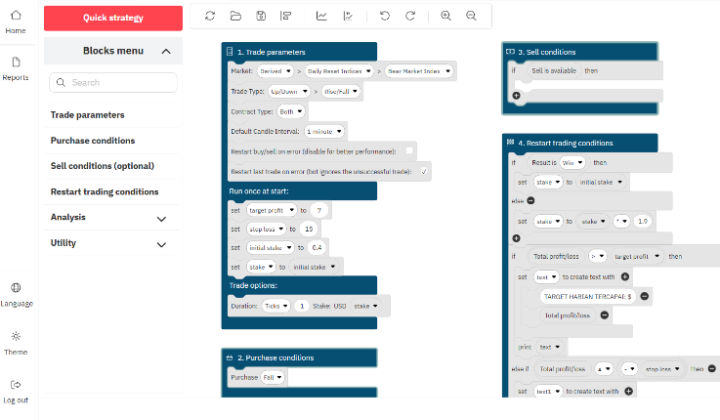
- Choose Your Logic: Decide if you are going to buy a pre-made bot, hire a developer, or build one yourself using a “no-code” builder.
- Backtest, Backtest, Backtest: Run your strategy against at least a year of historical data. If it doesn’t work in the past, it won’t work in the future.
- Demo Trade: Run the bot on a demo account for at least two weeks. This will help you see how it handles real-time latency and slippage.
- Go Live with “Cents”: Start with the minimum trade size possible. Only scale up once you see consistent performance over hundreds of trades.
The Future of the Algorithmic Trader
Where do we go from here? As AI continues to evolve, high frequency trading binary bots will only become more adaptive. We are moving toward a world where bots will be able to rewrite their own code on the fly to adjust to changing market conditions. It sounds like science fiction, but we are already seeing the first iterations of this in 2026.
However, no matter how smart the machine becomes, the human element will always be the most important part of the equation. It is your curiosity, your risk tolerance, and your willingness to learn that will determine your success. The bots are just tools—powerful, lightning-fast tools—but tools nonetheless.
If you approach this with respect for the market’s complexity and a healthy dose of skepticism toward “overnight wealth,” the world of automated binary trading can be incredibly rewarding. Just remember to keep your software updated, your VPS running, and your eyes on the data. The next millisecond is already here—are you ready for it?