
The Reality of Trading with Small Accounts in 2026
Let’s be honest for a second. We’ve all seen those flashy videos. You know the ones—somebody clicks a button on a “magic” bot, and suddenly their $10 account turns into $10,000 in twenty minutes while they sip a latte. It looks easy, it looks effortless, and in the year 2026, with all the technological leaps we’ve made, it’s even more tempting to believe. But if you’ve actually tried it, you probably know the sinking feeling of watching your last $5 vanish because the market decided to spike the wrong way.
Trading with a small capital is arguably the hardest way to trade. Why? Because you have no room for error. When you have a $5,000 balance, a $10 loss is a minor scratch. When you have a $20 balance, a $10 loss is a catastrophe. That is exactly why a low balance binary bot strategy isn’t just about the code or the indicators—it is about a survivalist mindset. We aren’t trying to hit a home run every day; we are trying to stay in the game long enough to let the math work in our favor.
Why Most Bots Bleed Your Account Dry
Most traders download a free bot, plug in their $10 or $20, and set the Martingale to ‘aggressive.’ Within ten minutes, the market enters a long streak of losses, the bot keeps doubling the stake, and—poof—the account is gone. The problem isn’t the bot; it’s the lack of a buffer. Traditional bots are designed for accounts that can handle 7, 8, or 10 consecutive losses. A tiny account can barely handle 4. To succeed in 2026, we have to flip the script and use logic that protects the pennies while they grow into dollars.

Building Your Low Balance Binary Bot Strategy
If you’re working with a limited budget, your bot needs to be smarter, not louder. You can’t bully the market with a huge wallet, so you have to outmaneuver it with timing and precision. Here is how we break down a sustainable approach for small accounts.
The “Wait for the Loss” Logic (Virtual Hook)
One of the most effective components of a low balance binary bot strategy is what I like to call the “Virtual Hook.” Instead of the bot placing a real trade immediately, it monitors the market and simulates trades in the background. For example, if you are trading ‘Digits’ or ‘Rise/Fall,’ you tell the bot: “Wait until there are 3 consecutive losses on paper, and only then place a real trade.”
By doing this, you are statistically avoiding the most common losing streaks. You aren’t fighting the trend; you are waiting for the trend to exhaust its losing potential before you put your hard-earned money at risk. In 2026, most advanced bot platforms allow for this kind of conditional logic, and it is a total game-changer for those of us starting small.
Risk Management: The 2% Rule Doesn’t Work Here
You often hear gurus say, “Only risk 2% of your account per trade.” Let’s do the math. If you have $10, 2% is $0.20. Most platforms have a minimum trade of $0.35 or $0.50. You literally cannot follow the 2% rule. This is why we use a ‘Recovery Tier’ system instead of a pure Martingale.
- Tier 1: Minimum stake (e.g., $0.35).
- Tier 2: If Tier 1 loses, stay at $0.35 or slightly increase to $0.40.
- Tier 3: Only after two losses do you actually double the stake.
This slower progression gives you more “lives” in the game. It’s better to take longer to recover a loss than to blow the entire account in a desperate attempt to get back $0.35 in one go.
The Best Markets for Small Balances in 2026
Not all markets are created equal, especially when your balance is thin. High volatility is your friend if you have a massive account, but it’s a nightmare for a small one. If the market is jumping around like a caffeinated kangaroo, your bot will get caught in “noise” and trigger false signals.
Synthetic Indices: The 24/7 Playground
For a low balance binary bot strategy, synthetic indices (like Volatility 10 or 25) are often superior to traditional Forex pairs. Why? Because they are mathematically generated to provide smooth, consistent price action regardless of global news or bank holidays. In 2026, the algorithms behind these indices have become very sophisticated, allowing bots to track patterns with much higher accuracy than the chaotic EUR/USD pair during a news release.
I personally prefer the ‘Volatility 10 Index’ for small accounts. It’s slow, steady, and doesn’t have the violent price gaps that blow accounts in seconds. It allows your indicators—whether it’s an RSI or a simple Moving Average—to actually mean something.

Setting Up Your Bot Logic: A Practical Walkthrough
Let’s get into the nitty-gritty of how you should actually configure your bot. Imagine we are building a bot that targets the ‘Over/Under’ market. Many traders love ‘Digit Under 8’ because it has a high win rate (around 80%). However, the payout is tiny. If you lose once, you need four or five wins just to break even.
The Modified Smart-Staking Approach
Instead of just blindly running an ‘Under 8’ bot, we add a filter. We only trade when the last three digits shown in the market were above 5. This increases the probability that the next digit will be lower. It’s a simple statistical “mean reversion” concept. When you combine this with a small account, you aren’t just gambling; you are picking your spots.
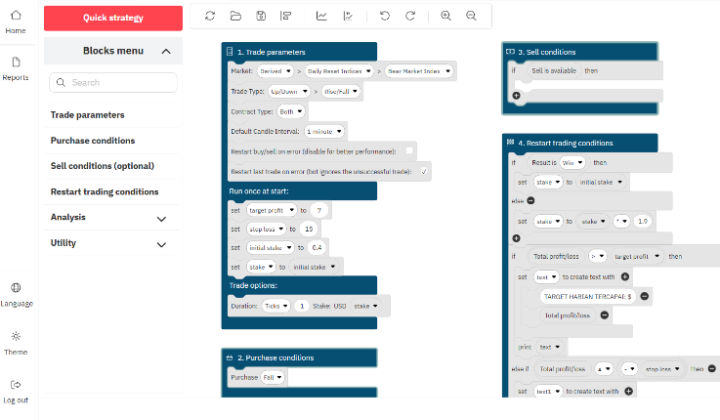
Here is a configuration that has saved my skin many times:
- Stake: $0.35
- Target Profit: $1.00 to $2.00 per session (Yes, be humble!).
- Stop Loss: $3.00 (Protect your remaining $7 at all costs).
- Logic: Wait for a “Loss” in virtual mode before entering.
- Martingale Multiplier: 1.5x (instead of 2.1x). It takes longer to recover, but it keeps the stakes low.
Micro-Compounding: The Path to Growth
The secret to a low balance binary bot strategy isn’t making $50 in a day. It’s making $2, then stopping. Then making $2 tomorrow. If you start with $10 and make 10% a day, your account grows exponentially. The problem is that most people get greedy at $15 and want to hit $50. That is when the bot hits a bad streak, and because the balance is still relatively low, it can’t survive. Discipline is your only real edge here.
Avoiding the Death Spiral: The Psychological Game
Trading with a bot feels mechanical, but the person behind the ‘Start’ button is human. I’ve been there—watching the bot lose three trades in a row, feeling my heart rate climb, and resisting the urge to manually override it or, worse, increase the stake to “force” a win. This is the ‘Death Spiral.’
When you have a low balance, every loss feels personal. To counter this, you must treat your bot like an employee. You give it a task, you set its limits, and you walk away. If it hits the stop loss, the “employee” is done for the day. You don’t fire it, you don’t scream at it, and you certainly don’t give it more money to play with. You simply come back when the market conditions have changed.
The “Market Condition” Filter
In 2026, the best bots come with built-in filters that detect ‘choppy’ versus ‘trending’ markets. If you are using a low balance binary bot strategy, you should never run your bot 24/7. Use it for 30 minutes, hit your small target, and close the tab. The longer a bot runs, the higher the chance it will eventually hit that one-in-a-million losing streak that clears your account.
Technical Indicators That Actually Help
For small accounts, you want indicators that signal exhaustion. I find that a combination of the RSI (Relative Strength Index) and Bollinger Bands works wonders for binary bots.
Think about it: if the price touches the upper Bollinger Band and the RSI is above 70, the chances of the next few ‘ticks’ being downward are very high. A bot programmed to look for this specific confluence of events will have a much higher win rate than a bot that just trades based on random digit patterns. By increasing your win rate, you reduce the need for aggressive Martingale, which is the ultimate goal for a small account.
The Power of Patience
I remember a friend who started with just $15. He used a very conservative bot that only traded once every ten minutes when a specific set of conditions were met. Most people laughed at him. “You’re only making $0.50 an hour!” they said. But while they were blowing $100 accounts trying to be fast, he was slowly building a cushion. By the end of the month, his $15 was $60. He then had the “buffer” to trade slightly higher stakes. That is how you win the long game.
Summary of the Strategy for 2026
To wrap this up, let’s look at the pillars of a successful approach. Trading with a low balance isn’t a death sentence for your account; it’s a training ground for discipline. If you can manage $10, you can manage $10,000. But if you can’t respect the small numbers, you’ll never see the big ones.
- Always use Virtual Hooks: Never let your first trade be a real one if you can avoid it.
- Limit your sessions: 15-30 minutes is plenty. Get in, get your profit, get out.
- Use conservative recovery: Don’t double your stake every time. Try a 1.2x or 1.5x multiplier to stay in the game longer.
- Focus on Volatility Indices: They offer the consistency a small account needs to survive.
- Stop Loss is non-negotiable: If you lose your daily limit, walk away. The market will be there tomorrow.
By implementing a low balance binary bot strategy with these rules, you aren’t just gambling on a piece of software. You are building a systematic approach to wealth. It might start small, and it might feel slow, but in the world of automated trading, slow and steady doesn’t just win the race—it survives to see the finish line.
Remember, the goal for 2026 is automation with intelligence. Use the tools available to you, stay disciplined, and treat every cent like it’s a dollar. Happy trading!