
The Dreaded Red Line: Why Your Account Security Depends on This One Metric
It’s 3:00 AM, the London session just kicked off, and you’re staring at your MT5 dashboard with a sinking feeling in your stomach. You’re down 4% on your $100,000 funded account. The “hard breach” level is 10%. You feel that physical tightness in your chest—the one that tells you you’re just a few bad trades away from losing everything you worked months to earn. This isn’t just about losing money; it’s about losing the opportunity that a funded account represents. In 2026, where prop firm algorithms have become even more sophisticated at sniffing out reckless behavior, mastering maximum drawdown management for prop firms is no longer a luxury—it’s the fundamental skill that separates the professionals from the gamblers.
I’ve seen brilliant traders—people who can call a market turn with surgical precision—lose $200k accounts in a single afternoon. Why? Not because their strategy stopped working, but because they treated their drawdown like a suggestion rather than a stone-cold limit. Let’s talk about how to survive the dip and keep your capital intact when the market decides to get messy.
Understanding the Math of the Hole
Most traders think about drawdown linearly, but the math of recovery is actually geometric. If you lose 5% of your account, you need a 5.26% gain to get back to break-even. If you hit 10% drawdown, you need an 11.1% gain. But if you slide into a 20% hole? You suddenly need a 25% gain just to see your starting balance again. When you’re trading for a prop firm, you usually don’t even have the luxury of a 20% cushion. Most firms cap your total loss at 8% to 12%.
This means your operational ceiling is much lower than you think. Effectively managing maximum drawdown management for prop firms requires you to treat your 10% max loss limit as if it were 100% of your available capital. If the firm says you can lose $10,000, that $10,000 is your entire world. Losing $5,000 isn’t “just 5% of the account balance”; it’s 50% of your life support. When you shift your perspective this way, your risk appetite changes instantly.
The 2026 Landscape: Evolution of Drawdown Rules
Prop firms in 2026 have shifted away from the simple “end-of-day” balance checks. Most now utilize high-frequency equity tracking. This means that if your open trades dip below the drawdown limit for even a millisecond, your account is flagged. This change has made maximum drawdown management for prop firms significantly more challenging for those used to “holding through the noise.”
Relative vs. Absolute vs. Trailing Drawdown
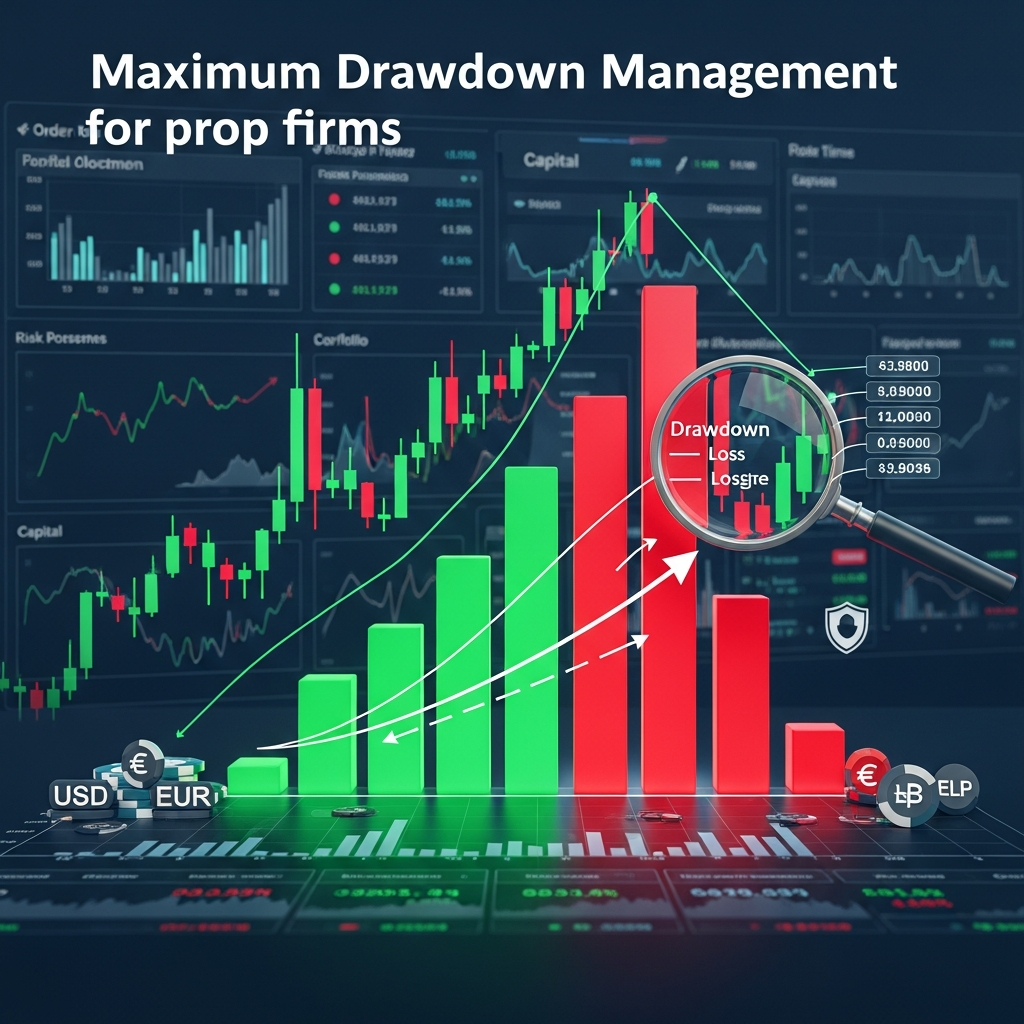
- Absolute Drawdown: The most straightforward. If you start with $100k and the limit is 10%, you can’t go below $90k. Period.
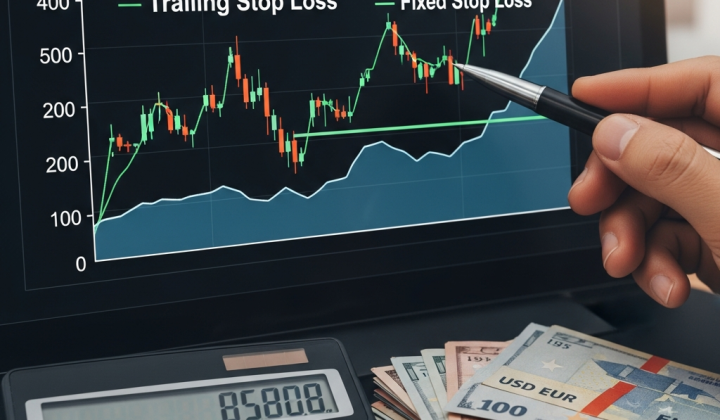
- Relative/Trailing Drawdown: This is the silent killer. As your account balance grows, the floor moves up with it. If you grow that $100k to $105k, your new floor might be $95k. If you then drop back to $100k, you’ve used up 50% of your allowed drawdown even though you’re at your starting balance.
- Daily Drawdown: A separate beast entirely. Usually 4-5% of the starting equity of the day. This is designed to stop “revenge trading” spirals.
The Architecture of a Proper Risk Plan
To succeed, you need a mechanical framework. You can’t rely on your “gut feeling” when the heat is on because your gut is programmed by millions of years of evolution to either fight or flee—neither of which helps you manage a complex EUR/USD position.
1. The “Step-Down” Lot Sizing Strategy
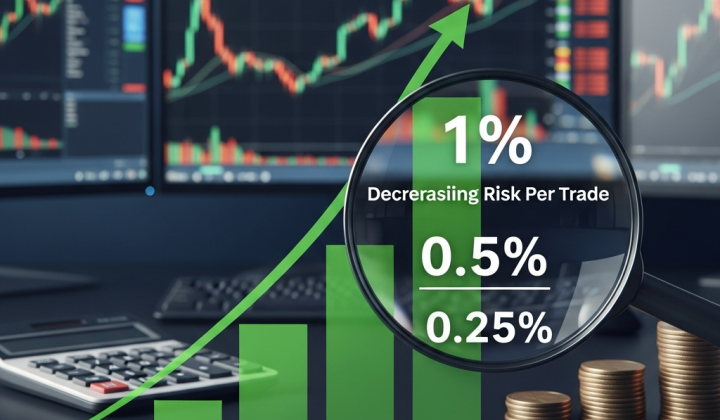
One of the most effective ways to implement maximum drawdown management for prop firms is to reduce your risk as you get closer to your limit. Imagine you start by risking 1% per trade. If you hit a 3% drawdown, you don’t keep risking 1%. You drop your risk to 0.5%. If you hit 5% drawdown, you drop it again to 0.25%.
This “tapering” approach effectively stretches out your remaining “life” in the account. It gives you more attempts to find a winning streak without hitting the hard cap. Yes, it takes longer to recover, but the goal is survival. You can’t recover if the account is closed.
2. Correlation Awareness: The Silent Account Blaster
I once knew a trader who thought he was diversified because he was long on GBP/USD, EUR/USD, and AUD/USD. When the US Dollar spiked on an NFP print, all three trades hit their stop losses simultaneously. He didn’t just lose 1%; he lost 3% in four seconds. That isn’t trading; that’s an accident waiting to happen. True maximum drawdown management for prop firms involves checking your correlation matrix daily. If your trades are more than 70% correlated, you are essentially just doubling your lot size on the same trade. Limit your total “thematic” exposure to a fixed percentage of your max drawdown.
3. The “Breather” Rule
In 2026, the markets move faster than ever due to AI-driven institutional flows. It is incredibly easy to get “tilted.” A human-centric approach to management involves a mandatory “Breather” rule. If you lose two trades in a row, or if you hit 50% of your daily drawdown limit, you must close the laptop for 4 hours. No exceptions. No “just one more setup to get back to break-even.” The market will be there in four hours. Your discipline might not be if you stay glued to the screen.
The Psychological Shift: Embracing the “Small Win”
When traders enter a drawdown, they often start looking for “home run” trades to fix the problem quickly. This is the fastest way to lose a prop account. Effective maximum drawdown management for prop firms requires the opposite: a focus on base hits. When you’re in a hole, your primary goal isn’t to make money; it’s to stop the bleeding and regain confidence.
Focus on high-probability, low-RR setups just to get some “green” back on the dashboard. Taking a 0.5% gain when you’re 4% down might feel insignificant, but it does wonders for your neurochemistry. It proves to your brain that you can still win. Trading out of a drawdown is 90% psychological and 10% tactical.
Leveraging Technology for Safety
Since we are in 2026, we have tools that our predecessors could only dream of. Use them. There are dozens of “Equity Protector” EAs (Expert Advisors) available for MT4 and MT5. These are simple scripts that run in the background. You tell the script: “If my equity drops by $X today, close all trades and disable trading until tomorrow.”
This removes the element of human willpower. We all like to think we have iron discipline, but in the heat of a losing streak, our brains betray us. An automated equity protector is your “digital conscience.” It doesn’t care about your feelings or your “certainty” that the price will bounce. It just executes the plan.
Common Pitfalls in Drawdown Management
Even with a plan, there are traps that catch 2026 traders off guard. Let’s look at the most common ones so you can avoid them.
- The Martingale Trap: Doubling down to recover losses faster. In a prop firm environment with a fixed max loss, Martingale is a mathematical certainty for account termination. Never, under any circumstances, add to a losing position to “lower your average entry.”
- News Gambling: High-impact news events (CPI, FOMC, etc.) can cause slippage. If you are 1% away from your max drawdown and you enter a trade right before a news release, a 20-pip slip can blow your account even if your stop loss was set correctly. Prop firms won’t care about slippage; they only care about the final number.
- Ignoring Swap and Commissions: When you’re hovering near your drawdown limit, the small costs add up. I’ve seen accounts breached because of triple-swap Wednesday. Keep a buffer for these hidden costs.
A Real-World Recovery Story
I remember a student of mine, Sarah, who was trading a $200k account. She had a bad week and found herself at $184,500. Her hard stop was $180,000. She was less than $5k away from losing everything. Most people would have panicked and started over-leveraging to “get back to $200k.”
Instead, Sarah practiced extreme maximum drawdown management for prop firms. She stopped trading for three days to reset her mind. When she came back, she reduced her risk from $1,000 per trade to just $200. She spent the next three weeks just trying to get back to $186,000. It was slow. It was boring. But she rebuilt her confidence trade by trade. Two months later, she was back in profit and eventually took a $12,000 withdrawal. She didn’t save the account with a great trade; she saved it with a great risk plan.
How to Build Your Drawdown Recovery Plan
If you find yourself in the “red zone” right now, here is your step-by-step checklist:
- Acknowledge the situation: Stop pretending “it’s just a temporary dip.” Admit you are in drawdown and that your current strategy needs adjustment for this market environment.
- Halve your risk: Whatever you were risking per trade, cut it in half immediately. If you’re really deep, cut it by 75%.
- Limit your active trades: Reduce the number of pairs you’re watching. Focus on one or two high-liquidity pairs like EUR/USD or Gold where spreads are tight and price action is cleaner.
- Tighten your Profit Targets: In a recovery phase, you want to see wins. Instead of waiting for a 1:3 RR, consider taking partial profits at 1:1 to secure some equity.
- Set an “Emergency Exit”: Determine a point before the actual prop firm limit where you will voluntarily stop trading for the month to preserve the account for the next cycle.
The Importance of Community and Accountability
Trading is lonely, and drawdown makes it lonelier. In 2026, many successful prop traders use accountability groups. Having someone to tell, “Hey, I hit my 2% daily limit, I’m out for the day,” makes a massive difference. It’s much harder to break your rules when you have to admit it to a peer group you respect. If you don’t have a group, start a trading journal where you write down why you’re following your maximum drawdown management for prop firms protocol. Seeing the “why” in your own handwriting can be a powerful deterrent against impulsive moves.
The Long Game
The secret that the top 1% of prop traders know is that the goal isn’t to make $50,000 in a month. The goal is to still be trading the same account a year from now. If you can keep the account, the profits will eventually come. Markets go through cycles of high and low volatility, and your strategy will naturally perform better in some months than others.
Your job during the “bad” months is simply to survive. Maximum drawdown management for prop firms is the armor you wear into the market every day. It might feel heavy, it might feel restrictive, but it’s the only thing that keeps you in the game when the arrows start flying. Treat your drawdown limit with the utmost respect, and the prop firms will continue to send you those payouts well into the future. Stay disciplined, stay calm, and remember: protection of capital is the first and most important job of any professional trader.