
The Myth of the Massive Start
Most people think you need a massive war chest to start trading. I used to believe that too. I remember staring at my first real brokerage account back in the day—it had exactly $450 in it—and thinking, “How am I supposed to make a living with this?” The truth is, you aren’t. Not yet, anyway. The biggest mistake beginners make isn’t having a small balance; it’s trying to trade that small balance as if it were a million-dollar fund.
When we talk about money management for small accounts under $1000, we are really talking about the art of survival. In 2026, the markets are faster and more accessible than ever, but the math of risk hasn’t changed since the 1920s. If you lose 50% of your account, you need a 100% gain just to get back to where you started. That’s a mountain nobody wants to climb.
I’ve seen countless traders blow through $500 or $800 in a single afternoon because they got bored. They felt that a $5 profit wasn’t worth their time, so they cranked up the leverage, took a massive position, and watched the market sneeze their balance into oblivion. To succeed, you have to treat your $800 account with the same discipline and respect as a $800,000 account.

The Psychology of the Small Stake
Let’s get real for a second. The hardest part of money management for small accounts under $1000 isn’t the math—it’s your own brain. When you’re trading with $500, a 1% risk is only $5. It’s tempting to think, “It’s just five bucks, who cares?” That mindset is the kiss of death. Once you stop respecting the small numbers, you lose the ability to manage the big ones.
Psychologically, small accounts are harder to trade than large ones. Why? Because the rewards feel insignificant relative to the effort. You might spend three hours analyzing a setup, execute it perfectly, and walk away with a $12 profit. It feels like a waste of time. But you aren’t trading for the $12; you’re trading for the skill. In 2026, with the rise of fractional shares and micro-lot Forex trading, the barrier to entry is gone, but the barrier to discipline remains as high as ever.
I remember a friend who tried to “flip” a $300 account. He doubled it in three days by taking huge risks. On the fourth day, he lost it all plus his initial deposit. He wasn’t trading; he was gambling. If you want to grow, you have to embrace the slow grind. You have to be okay with those $10 wins because they represent a winning process.
The 1% Rule: Your Lifeline in the Market
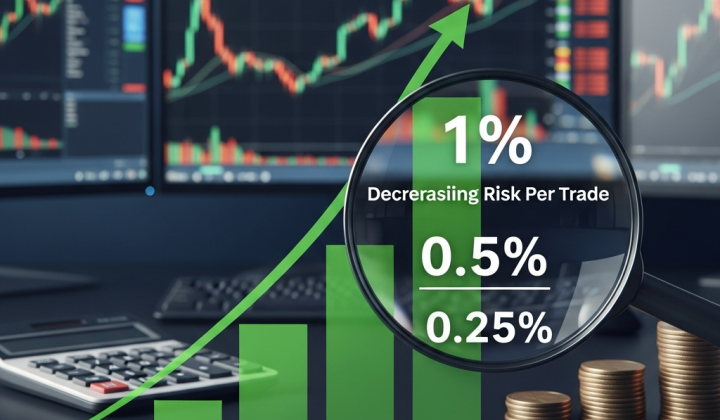
If there is one golden rule in money management for small accounts under $1000, it is this: never risk more than 1% to 2% of your account on a single trade. I know, I know—you’ve heard it a thousand times. But let’s look at why it’s non-negotiable for a small account.
If you have $1000 and you risk 1%, you are risking $10. If you hit a losing streak of ten trades—which happens to the best of us—you still have $900 left. You’re still in the game. But if you risk 10% ($100) per trade, that same losing streak wipes you out completely. You can’t learn if you’re out of chips.
Using 2026 trading tools, you can easily automate these calculations. Whether you are using MT5 or a specialized prop firm platform, ensure your position size is calculated based on your stop-loss distance. If your stop-loss is 20 pips away on a Forex pair, and you only want to risk $10, you need to use micro lots (0.01 or 0.05). Never just “eyeball” it. The market doesn’t care about your gut feeling; it only cares about the orders on the book.
Position Sizing and the Power of Micro Lots
A few years ago, trading a small account was a nightmare because of high commissions and large minimum lot sizes. Today, things are different. For anyone focusing on money management for small accounts under $1000, micro lots are your best friend. A micro lot (0.01) represents 1,000 units of the base currency. In many pairs, this means a one-pip move is worth roughly 10 cents.
This granularity is a superpower. It allows you to fine-tune your risk. If your strategy requires a wide stop-loss to give the trade room to breathe, you can drop down to a single micro lot. If the setup is tight and high-probability, maybe you move up to three or four micro lots. This flexibility is what allows a small account to survive the volatility of 2026’s global markets.
Calculating the “Risk per Pip”
- Identify your account balance (e.g., $800).
- Decide on your risk percentage (e.g., 1.5% = $12).
- Determine your stop-loss distance in pips (e.g., 30 pips).
- Divide your risk amount by the pips ($12 / 30 = $0.40 per pip).
- Choose the lot size that matches that value (in this case, 0.04 lots).
By doing this every single time, you remove the emotional weight of the trade. You already know exactly how much you will lose if the market goes against you. That certainty is what keeps your head clear.
The Risk-to-Reward Ratio Advantage
Small accounts cannot afford to win small and lose big. You need an edge, and that edge often comes from a positive risk-to-reward (R:R) ratio. Aim for at least 1:2. This means for every $10 you risk, you are aiming to make $20.
Why is this so vital? Because it gives you room to be wrong. If you have a 1:2 ratio, you only need to win about 34% of your trades to break even. If you can hit a 50% win rate, your account will grow steadily. People often get obsessed with finding a “Holy Grail” indicator that wins 90% of the time. They don’t exist. Successful money management for small accounts under $1000 relies on the math of the R:R ratio, not the perfection of the entry.
I’ve seen traders with 70% win rates go broke because they didn’t use stop-losses and let their losers run, hoping they would turn around. Meanwhile, I know traders who lose more than they win but are highly profitable because they cut their losses at $10 and let their winners run to $30 or $40.
Avoiding the “Penny Wise, Pound Foolish” Trap
When you have a small account, every penny counts. This leads many beginners to choose the wrong brokers. They look for the ones offering the biggest “bonuses,” which are usually just traps to get you to over-leverage. Instead, look for brokers with the lowest spreads and minimal commissions.
In 2026, competitive spreads are the norm, but they can still eat a small account alive if you are over-trading. If you’re trading a $600 account and your spread plus commission costs you $2 per trade, you’re already starting 0.3% in the hole. If you take five trades a day, that adds up fast. Be selective. Quality over quantity is the mantra for small account holders.
Tips for Choosing a Broker for Small Accounts:
- Verify they allow micro-lot (0.01) trading.
- Check if they offer “Cent Accounts” if your balance is actually under $200.
- Look for low-latency execution to avoid slippage.
- Ensure they are regulated by a reputable body; your capital is too small to risk on a scam.
The Compounding Snowball
The most boring part of money management for small accounts under $1000 is waiting for compounding to kick in. But it is also the most magical. If you have a $1000 account and you manage to grow it by just 5% a month—which is very doable with disciplined risk—you aren’t just making $50.
By the end of the first year, that $1000 becomes roughly $1,800. By the end of the second year, it’s over $3,200. By year five? You’re looking at nearly $19,000. All from a single $1000 start without adding another dime. The problem is that most people want the $19,000 next Tuesday. They take on too much risk, blow the account, and then spend the next five years complaining that trading is a scam.
Compounding is a test of character. It asks you: “Can you be patient enough to become wealthy?” Most people’s answer, unfortunately, is no. But if you can say yes, you’re ahead of 95% of the market.
Practical Habits for the Under-$1000 Trader
To stay on track, you need a routine. First, keep a trading journal. I don’t care if it’s a fancy AI-integrated dashboard or a spiral notebook. Record every trade, why you took it, and how much you risked. When you see your mistakes in black and white, they become harder to repeat.
Second, stop checking your P&L (Profit and Loss) in dollar terms during the trade. Switch your platform to show pips or percentages. Looking at “+$14.50” might make you want to close the trade early out of fear of losing it. Looking at “+15 pips” keeps you focused on the technicals of the move.
Third, have a “daily max loss” limit. If you lose 3% of your account in one day, turn off the computer. Walk away. The market will be there tomorrow. Revenge trading is the fastest way to turn an $800 account into a $0 account. I’ve been there, staring at a screen at 2 AM trying to “win back” a loss, only to dig a hole so deep I couldn’t get out. Don’t be that person.
Final Thoughts for the Small Account Journey
Trading with a small balance is actually a gift. It is a low-cost education. Think of that $1000 as tuition. If you can learn to manage it effectively, you are building the foundation for a career. If you can’t manage $1000, you will never be able to manage $100,000. The pressures only get bigger, the zeros only get more intimidating.
Focus on the process, respect the math, and stay patient. The goal of money management for small accounts under $1000 isn’t to get rich quick—it’s to develop the habits of a professional trader so that when you eventually have more capital, you know exactly what to do with it. You’ve got this. Just stay in the game.