The Great Trading Debate: Why Choosing Matters
I still remember the first time I sat down to build a trading bot for Deriv. I had this grandiose idea for a strategy that would scalp the Volatility 75 Index using a mix of RSI and Bollinger Bands. At the time, I was staring at two very different paths: the colorful, Lego-like blocks of the XML-based DBot and the intimidating, text-heavy world of Python. It felt like choosing between a bicycle with training wheels and a fighter jet. Both could get me moving, but only one would keep up with the chaos of the markets.
Fast forward to 2026, and the landscape has evolved significantly. The community is more divided than ever. If you hang out in any trading forum or Discord group, the question of python vs xml for deriv bots inevitably pops up every single day. Is one actually better than the other? Or does it all just boil down to how much you enjoy staring at curly braces versus dragging puzzle pieces across a screen?
Let’s get real for a second. Trading isn’t just about the strategy; it’s about the execution. If your bot takes too long to process a signal or crashes the moment the market gets volatile, the best strategy in the world won’t save your account. That’s why picking the right foundation is the most critical step you’ll take before you ever place a trade.
Understanding the XML Block-Based Universe
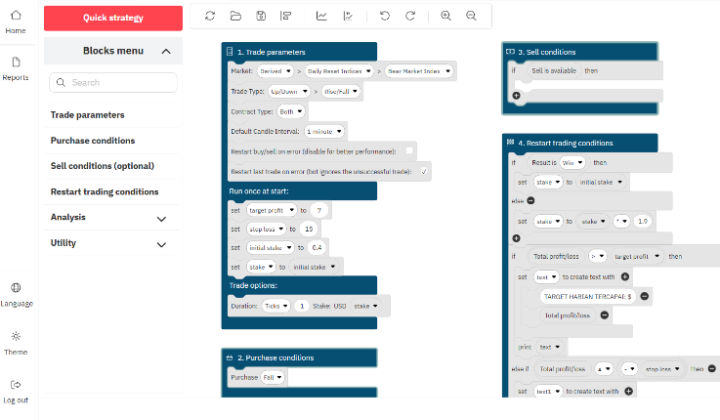
When we talk about XML in the context of Deriv, we’re really talking about DBots. These are the visual, drag-and-drop interfaces that allow you to build logic without writing a single line of code. The underlying files are saved as .xml, which stores all those visual connections in a structured format that the Deriv engine understands.
The beauty of the XML approach is its accessibility. If you can understand a flowchart, you can build a DBot. I’ve seen traders who have never touched a line of code in their lives build incredibly complex Martingale or grid systems in an afternoon. It’s visual, it’s intuitive, and it gives you immediate feedback. You see the block for “Purchase,” you snap it onto the block for “Trend is Up,” and boom—you have a bot.
However, there’s a ceiling. I hit that ceiling about six months into my journey. As my strategies grew more sophisticated, my XML workspace started looking like a bowl of digital spaghetti. Hundreds of blocks were interconnected, and finding a single logic error became a scavenger hunt from hell. If you want to do something specialized, like calculating a custom weighted moving average that isn’t built-in, you’re going to have a hard time.
Python: The Professional’s Playground
Then we have Python. By 2026, Python has become the undisputed king of financial technology. It’s no longer just for data scientists; it’s for anyone who wants absolute control over their trading destiny. When you use Python for Deriv bots, you aren’t clicking buttons; you’re communicating directly with the Deriv API.
The first thing you notice when switching to Python is the freedom. You aren’t restricted by what blocks Deriv decided to give you. You have access to libraries like Pandas for data manipulation, NumPy for math, and TA-Lib for every technical indicator ever conceived. If you want to integrate an AI model to predict price action based on sentiment analysis, Python is your only real choice.
But let’s be honest: Python has a steep learning curve. I remember spending three days just trying to get my authentication token to work correctly without throwing a 401 error. There are no colorful blocks to guide you. If you miss a comma or a colon, your bot simply won’t run. It requires a level of discipline and attention to detail that many casual traders aren’t ready for.
Comparing Python vs XML for Deriv Bots in 2026
To really settle this, we need to look at the specifics. We’re looking at how these two stack up in the high-stakes environment of 2026 trading.
Speed and Execution
In the world of synthetic indices, milliseconds matter. XML bots run in the browser or on Deriv’s hosted environment. While they are relatively fast, they are still limited by the overhead of the visual engine. Python, on the other hand, can be run on a dedicated VPS (Virtual Private Server) located as close to Deriv’s servers as possible. The raw execution speed of a well-written Python script will almost always outperform an XML bot. If you’re scalping one-minute candles, Python gives you that competitive edge.
Logic Complexity and Debugging
This is where the python vs xml for deriv bots debate gets spicy. Have you ever tried to debug a block-based bot? You have to click through layers of blocks, checking every dropdown. It’s tedious. In Python, you have robust logging. You can tell your bot to write a message to a file every time it makes a decision. If something goes wrong, you just check the logs and see exactly where the logic failed. Python’s ability to handle “Try/Except” blocks means your bot can recover from a lost internet connection or an API hiccup gracefully, whereas an XML bot might just stop dead in its tracks.
Flexibility and Data Handling
XML is a walled garden. You get the data Deriv gives you, and you stay inside their ecosystem. Python is an open field. Want to pull data from a different exchange to see if it correlates with your Deriv index? Easy. Want to save every single tick of data to a database for backtesting later? Python does that while you sleep. The ability to handle large datasets is the reason serious quant traders never look back once they leave XML behind.
When Should You Stick with XML?
Despite my love for Python, I don’t think XML is dead. Not by a long shot. In fact, for a large segment of the trading community, XML is actually the better choice. If you are just starting out, or if your strategy is simple, don’t overcomplicate things. If you just want to run a basic RVI crossover on a Volatility 100 index, building a Python script is like using a sledgehammer to crack a nut.
XML is also fantastic for rapid prototyping. Even now, if I have a wild idea for a new strategy, I might spend 10 minutes throwing blocks together in DBot just to see if the core concept holds water. It’s a great “sketchbook” for traders. If the idea works, I then move it over to Python for the heavy lifting.
Why You’ll Eventually Move to Python
Most traders follow a similar trajectory. They start with XML because it’s approachable. They make some money, they lose some money, and they realize they need better risk management. They want to implement trailing stops that aren’t available in the standard blocks, or they want their bot to stop trading after three consecutive losses across different assets.
As you grow, your needs grow. You start wanting to backtest your strategy against historical data—real backtesting, not just running it on a demo account for an hour. Python allows you to run thousands of simulations in minutes. Once you experience that level of insight, going back to the “guess and check” method of XML feels like stone-age technology.
The Hybrid Reality of 2026
Interestingly, the line between python vs xml for deriv bots has started to blur this year. We’re seeing more tools that allow for a hybrid approach. Some developers are creating “custom blocks” for the XML environment using JavaScript, while others are using AI to instantly convert XML logic into Python code.
I’ve seen traders who use XML for their entry signals but use a Python script running in the background to monitor their overall account exposure and handle the “emergency kill switch.” This hybrid approach takes the ease of use from one and the power of the other. It’s a smart way to work if you’re in that awkward middle ground of being a competent trader but a novice coder.
The Pain of the Learning Curve
Let’s talk about the frustration for a moment. If you choose the Python route, you will face moments where you want to throw your laptop out the window. You’ll deal with library version mismatches, API rate limits, and the occasional “NoneType object has no attribute ‘get'” error that makes you question your intelligence.
But here’s the secret: every hour you spend struggling with Python is an investment in a skill that is valuable far beyond trading. You’re learning how to automate, how to analyze data, and how to think logically. When you finally see that terminal window scroll by with “Trade Successful” followed by a green profit line, the sense of accomplishment is ten times greater than just watching blocks light up.
Practical Tips for the Transition
If you’re currently using XML and looking at Python with envy, don’t jump into the deep end immediately. Here is how I suggest you handle the transition:
- Keep your XML bots running: If they are making money, don’t stop them. Use that profit to fund your learning time.
- Start with the Deriv API: Don’t try to learn all of Python at once. Focus specifically on how to connect to the Deriv API and pull a simple balance check.
- Use AI as a Tutor: In 2026, we have incredible AI coding assistants. Use them to explain what a specific line of code does. Don’t just copy-paste; ask the AI to break down the logic.
- Small Wins First: Don’t try to build a multi-asset neural network bot on day one. Build a bot that simply sends you a Telegram message when a certain price is hit.
Which One Wins for You?
So, where do we stand? In the battle of python vs xml for deriv bots, there is no universal winner—only a winner for your specific stage of the journey.
XML is the entry point. It’s for the visionary who wants to test ideas quickly and doesn’t want to get bogged down in syntax. It’s for the trader who values simplicity and visual clarity over raw power. It is a powerful tool, and in 2026, it is more capable than ever before.
Python is the destination. It’s for the trader who views their work as a business. It’s for the person who wants to squeeze every possible bit of efficiency out of the market. It’s for those who want to build something that isn’t just a bot, but a complete, automated trading system capable of handling anything the market throws at it.
Whatever you choose, remember that the tool is only as good as the person wielding it. A bad strategy will lose money in Python just as fast as it will in XML—perhaps even faster because Python will execute those bad trades with terrifying efficiency. Focus on your edge, manage your risk, and choose the platform that lets you sleep at night while your bot is out there hunting for pips.
The markets are waiting. Whether you’re snapping blocks together or typing out functions, the goal remains the same: consistency, discipline, and ultimately, freedom. Which path are you taking today?