
The Endless Search for the Perfect Entry
Let’s be honest: staring at a screen for eight hours straight watching green and red candles flicker is a special kind of mental exhaustion. You’ve been there. I’ve been there. You wait for that perfect Engulfing pattern or a Pin Bar at a key resistance level, but the moment you blink or head to the kitchen for a coffee, the move happens. You miss the entry, get frustrated, and then revenge trade into a loss. It is a cycle that breaks even the most disciplined traders.
This is exactly why the hunt for an automated candlestick pattern bot deriv has become the “holy grail” for many retail traders in 2026. We want the precision of price action analysis combined with the cold, unfeeling execution of a machine. We want to catch that Morning Star pattern at 3:00 AM while we are sound asleep. But how do you actually transition from manual charting to a fully functional bot on a platform like Deriv? It is not as simple as clicking a ‘profit’ button, but it is also not as gatekept as the big hedge funds want you to think.

Why Candlestick Patterns Still Rule the Charts
Before we dive into the automation side, we have to respect why we are using candlesticks in the first place. Indicators like RSI or MACD are “lagging”—they tell you what already happened. Candlestick patterns, however, are real-time representations of market psychology. An automated candlestick pattern bot deriv doesn’t just look at math; it looks at the battle between buyers and sellers.
Think about a ‘Hammer’ pattern. It tells a story: the bears tried to push the price off a cliff, but the bulls fought back and slammed the door shut. When you automate this, you are essentially coding ‘human sentiment’ into your execution. In 2026, the markets are faster than ever, and having a bot that recognizes these visual cues instantly gives you a massive edge over the person manually drawing lines on a tablet.
The Logic Behind the Automation
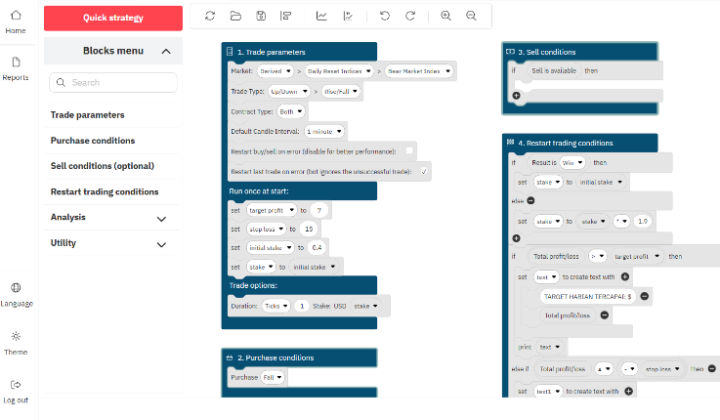
If you are using Deriv, you likely know about DBot or the legacy Binary Bot interface. These tools allow you to build logic blocks. To create an automated candlestick pattern bot deriv, you aren’t just telling the bot “buy when it goes up.” You are defining the relationship between the Open, High, Low, and Close (OHLC) of the candles.
- Engulfing Logic: The current candle’s body must be larger than the previous candle’s body, and it must wrap around it completely.
- Doji Logic: The difference between the Open and Close must be near zero, while the High and Low are significantly wider.
- Trend Filtering: No pattern should be traded in isolation. Your bot needs to know if the market is trending or ranging.
Setting Up Your Automated Candlestick Pattern Bot Deriv
I remember the first time I tried to build a bot. I made the mistake of trying to make it too complex. I wanted it to find Haramis, Stars, Gaps, and Marubozus all at once. The result? It never traded because the conditions were too perfect to ever happen. The secret to a successful automated candlestick pattern bot deriv is simplicity and high-probability setups.
On the Deriv platform, specifically using DBot, you can use the ‘Tick’ or ‘Candle’ analysis blocks. To get a candlestick bot running, you need to set your interval—say, 1-minute or 5-minute candles. The bot then stores the data of the ‘Last Candle’ and compares it to the ‘Current Candle’. This comparison is the heartbeat of your automation.
The Power of Synthetic Indices
One of the biggest reasons traders use Deriv for automation is the availability of Synthetic Indices like Volatility 75 (V75) or the Crash/Boom indices. Unlike Forex, these markets run 24/7/365. An automated candlestick pattern bot deriv can run on a Saturday night when the rest of the financial world is closed. These indices are also mathematically generated to mimic real market behavior, making them highly responsive to classic price action patterns.

Avoiding the Common Bot Traps
Let’s have a real talk for a second. If you go onto a forum and download a free “God-Mode Bot,” you are probably going to blow your account. Most ‘out-of-the-box’ bots are designed with Martingale strategies that look great on a backtest but fail miserably when a real-market trend goes against them. When you are building or configuring your automated candlestick pattern bot deriv, you have to prioritize risk management over the pattern itself.
The pattern is just the trigger. The risk management is the engine. A bot that looks for a ‘Piercing Line’ pattern but has no stop loss is just a ticking time bomb. In my experience, the most profitable bots are those that take small, consistent wins and have a ‘hard stop’ for the day if things go sideways. You have to treat your bot like an employee: give it clear instructions, a budget, and fire it if it stops following the rules.
Optimization for 2026 Market Conditions
The markets in 2026 are characterized by high volatility spikes. A bot that worked in 2022 might get shredded today. This is why you need to build a ‘Volatility Filter’ into your automated candlestick pattern bot deriv. If the candles are too small (low volume) or too massive (news events/spikes), the bot should stand down. Trading is often about the trades you *don’t* take.
Step-by-Step Logic for a Bullish Engulfing Bot
If you were to sit down today and start building, here is the mental framework you would follow for a basic Bullish Engulfing setup on Deriv:
- Step 1: Check the Previous Candle. Was it bearish? (Close < Open).
- Step 2: Check the Current Candle. Is it bullish? (Close > Open).
- Step 3: Compare Sizes. Is the Current Candle’s Close higher than the Previous Candle’s Open? Is the Current Candle’s Open lower than the Previous Candle’s Close?
- Step 4: Trend Confirmation. Is the 20-period Moving Average pointing up? If yes, execute ‘Rise’ or ‘Buy’.
- Step 5: Exit Strategy. Take profit after a certain number of candles or when a reversal pattern (like a Shooting Star) appears.
By following this structure, your automated candlestick pattern bot deriv becomes a systematic tool rather than a gambling machine. You are trading a documented edge, not a “feeling.”
The Psychology of Letting Go
The hardest part of using an automated candlestick pattern bot deriv isn’t the coding—it’s the sitting on your hands. You will see the bot take a loss, and your instinct will be to jump in and “fix” it. Or you’ll see a pattern that you *think* is perfect, but the bot ignores it because it doesn’t fit the strict mathematical criteria you set.
You have to trust the process. The reason we automate is to remove the human element. Humans are greedy, fearful, and tired. The bot is none of those things. If you’ve backtested your strategy and the numbers hold up, let the bot do its job. The most successful traders I know in 2026 spend more time reviewing their bot’s logs at the end of the week than they do looking at live charts.
Final Thoughts on Automation on Deriv
The transition to using an automated candlestick pattern bot deriv is a major milestone in a trader’s journey. It represents a shift from being a “worker” in the markets to being a “manager.” You are managing a strategy, managing risk, and managing your own time.
Whether you are building your own logic in DBot or using the Deriv API to connect a custom Python script, the goal remains the same: consistency. Start small, test on a demo account until you have a thousand trades under your belt, and never risk money you can’t afford to lose. The tools available in 2026 make this easier than ever before, but the fundamental rules of the market haven’t changed. Respect the price, manage the risk, and let the patterns do the heavy lifting.
So, what’s the next step? Open up the Deriv bot builder, pick one single pattern—just one—and try to define it using the block logic. You might find that the path to a more relaxed trading life starts with a single ‘Hammer’ candle and a bit of code.